


Most people buy a fire extinguisher, hang it on the wall, and never think about it again. That’s honestly one of the most common and dangerous mistakes in fire safety in Nepal. Fire extinguisher refilling and maintenance is not something you can ignore if you want real protection during emergencies.
A fire extinguisher isn’t a “set it and forget it” device. It needs regular checking, timely refilling, and proper care to actually work when you need it most. Think of it like a sleeping guard; if you don’t check it, it may fail you at the worst possible moment.
This guide covers everything you need to know: when to refill, what type you have, how the process works, what it costs in Nepal, and how to choose the right service provider. Let’s get into it.
Why Fire Extinguisher Refilling Matters in Nepal?
A fire extinguisher is a pressurized vessel. Over time, several things happen:
- Pressure Loss: Tiny leaks in the valve can cause the propellant gas to escape.
- Chemical Settling: In ABC extinguishers, the powder can clump at the bottom due to vibration or humidity.
- Corrosion: Nepal’s monsoon can lead to rust, weakening the cylinder wall.
The 30-Second Rule: A small fire can become uncontrollable in under two minutes. If your extinguisher fails because it wasn’t serviced, you lose the only window you had to stop a disaster.
A basic check takes minutes and should cover:
- Pressure gauge: needle in the green zone
- Pin and seal: tamper seal intact, pin properly in place
- Nozzle and hose: no cracks or blockages
- Cylinder body: no rust, dents, or corrosion
- Service label: dated within the last 12 months
An extinguisher on the wall looks like protection. Without regular servicing, it’s just a red cylinder.
How Often Should You Refill Your Extinguisher?
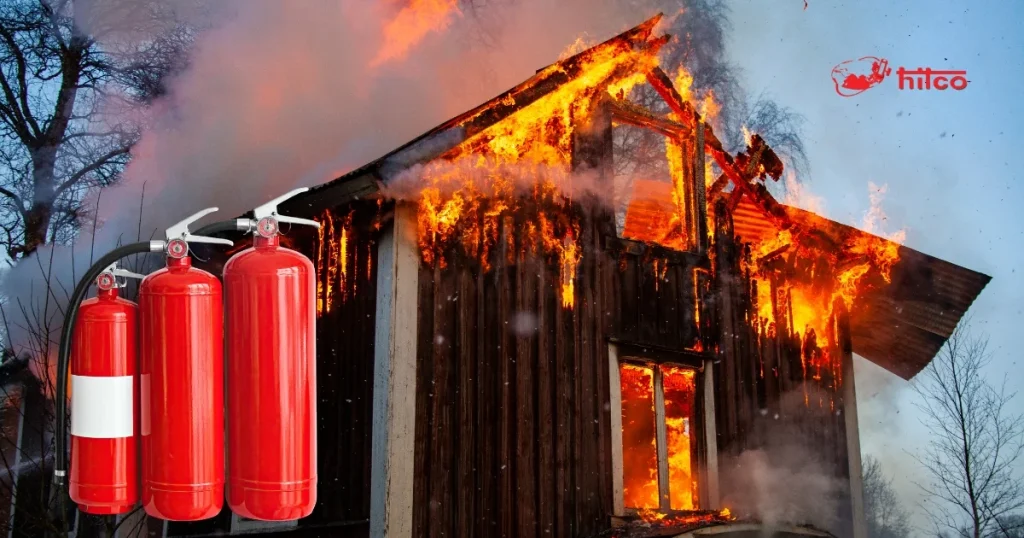
Knowing when to refill your extinguisher is just as important as owning one. In Nepal’s climate, the chemical agents inside can be affected by humidity and temperature, so you shouldn’t just wait for an emergency to check it.
Here are the four specific times you must refill your fire extinguisher:
Immediately After ANY Use: This is the most critical rule. Even if you only squeezed the handle for a split second, the pressure seal is now broken. The remaining gas will leak out over the next few hours, leaving the extinguisher empty and useless when you actually need it.
When the Pressure Gauge Drops: If you notice the needle has moved out of the green zone and into the red “Recharge” section, it needs an immediate refill. This can happen due to slow leaks or extreme temperature changes, even if the unit has never been fired.
Every 3 to 5 Years (Preventative Maintenance): For the common ABC Dry Powder extinguishers used in most Nepali offices and homes, the powder inside can “cake” or clump together over time. Professionals recommend refilling with fresh chemical agents every 3 to 5 years to ensure the powder doesn’t get stuck in the nozzle.
After Hydrostatic Testing: Every 5 to 10 years, your cylinder must undergo a high-pressure safety test. Since the unit is emptied for this process, it must be refilled with a fresh agent and re-pressurized before being placed back on your wall.
Don’t wait for a fire to find out your extinguisher is empty. If your service tag is outdated or the needle is low, schedule a refill today with certified fire extinguisher supplier.
Signs Your Fire Extinguisher Needs Refilling
If you see even one of these signs, don’t wait. Get it checked right away.
- The pressure needle is outside the green zone (too low or too high)
- The safety seal is broken or missing
- The inspection tag shows it’s past its service date
- You notice dents, rust, or visible damage on the body
- The nozzle is cracked or blocked
- The unit feels lighter than usual (important for CO₂ types)
Types of Fire Extinguishers and Their Refilling Needs
Not all fire extinguishers are created equal, and their maintenance requirements vary significantly. In Nepal, selecting the right type and knowing how to keep it ready is essential for effective fire protection. Here is a breakdown of the most common types and their specific refilling needs:
ABC Dry Powder Extinguishers
The most common ABC extinguisher Nepal uses is the “multi-purpose” type.
- Maintenance Tip: Once a month, turn the unit upside down and shake it gently. This prevents the powder from “caking” at the bottom.
- Refilling Need: These should generally be refilled every 3 to 5 years, even if unused. Because the powder is heavy, it can “cake” or clump at the bottom due to Nepal’s humidity.
Best For: Homes, offices, and warehouses.
CO₂ Extinguishers
CO₂ extinguishers in Nepal are the gold standard for server rooms and electrical panels because they leave zero residue.
- Maintenance Tip: These don’t have a pressure gauge; they are checked by weight. If the unit feels lighter than the “Gross Weight” marked on the shoulder, it has leaked.
- Refilling Need: CO₂ extinguishers typically require a refill and hydrostatic test every 5 to 10 years. However, they must be refilled immediately if any gas has been discharged.
Best For: IT rooms, laboratories, and sensitive electronics.
Foam Extinguishers
Used primarily for flammable liquids (petrol, oil).
- Maintenance Tip: The foam concentrate can degrade faster than powder. Ensure the “solution” is replaced during your annual service.
- Refilling Need: The foam concentrate is a liquid solution that can degrade faster than dry chemicals. It is often recommended to replace the foam solution every 2 to 3 years to maintain its fire-smothering effectiveness.
Best For: Garages, kitchens, fuel stations, and industrial workshops.
Not sure which one you need? Check our ABC vs CO2 fire extinguisher comparison guide.
Where to Install Your Fire Extinguishers Properly

Install a fire extinguisher and arrange for its service. Nepal’s awareness around placement is honestly quite low. People often put extinguishers wherever there’s space in a back corner, behind a cabinet, or sometimes in a locked room. That defeats the whole purpose.
Here’s where extinguishers should actually be placed:
- Kitchen: Mount it near the exit of the kitchen, not directly beside the stove. If a stove fire starts, you need to grab the extinguisher without reaching through flames. For a deeper breakdown on residential safety, check out our guide on how to choose a fire extinguisher for home in Nepal.
- Office: Near exits on each floor. In larger offices, the general rule is one extinguisher per 200–300 square feet, or one per floor at minimum. Learn more about proper safety setups in our checklist on selecting a fire extinguisher for commercial use in Nepal
- Near electrical panels and server rooms: A CO₂ extinguisher Nepal unit works best here. Keep it accessible but not directly beside the panel.
- Vehicles: A 1kg or 2kg ABC extinguisher under the seat or in the boot. It should be mounted securely, not rolling around loose.
- Stairwells and corridors: Especially in multi-story buildings. Fires spread fast through vertical spaces.
Signs Your Fire Extinguisher Needs Replacement
Sometimes refilling isn’t enough. There are situations where you need to replace the whole unit:
- The cylinder has deep rust, corrosion, or cracks; no amount of servicing fixes structural damage
- The valve or handle mechanism is broken and cannot be repaired
- The extinguisher has been in use for more than its rated lifespan (typically 5–10 years depending on type and manufacturer)
- It has failed a hydrostatic pressure test
- The extinguisher was in a fire or exposed to extreme heat; even if it looks okay, internal damage can be invisible
- The manufacturer label is completely worn off and the unit is unidentifiable
Basically, if the cylinder itself is compromised, don’t try to save it. Replace it. A new extinguisher is far cheaper than what a faulty one might cost you.
Step-by-Step Fire Extinguisher Refilling Process
Understanding how a professional extinguisher recharge works helps you trust the process and ask the right questions when you hand over your unit.
Step 1: Inspection The technician examines the full unit. They check for physical damage, corrosion, label legibility, and the condition of the valve, handle, and nozzle.
Step 2: Depressurizing and emptying The extinguisher is safely depressurized. Any remaining agent is discharged in a controlled environment. The cylinder is opened and fully emptied.
Step 3: Internal cleaning The inside of the cylinder is cleaned and inspected. For CO₂ units, moisture is a serious issue. For ABC powder units, caked powder is removed completely before refilling.
Step 4: Refilling the agent Fresh chemical agents are loaded as dry powder, CO₂, or foam concentrate based on the extinguisher type and rated capacity.
Step 5: Repressurizing and pressure testing The cylinder is sealed and recharged to the correct pressure. A pressure test confirms the unit holds charge safely without leaks.
Step 6: Sealing and labeling A new tamper seal and safety pin are fitted. A service tag is attached with the refill date, technician details, and next service date.
Professional companies like HITCO follow strict safety steps during refilling, which matters a lot for CO₂ units, especially where improper filling can be genuinely dangerous.
The Monsoon Factor: In Nepal’s high-humidity environment, ABC powder extinguishers are prone to moisture clumping.
Avoid Common Mistakes When Refilling Fire Extinguisher in Nepal
Out of sight, out of mind, but in fire safety, that can cost everything.
These are the mistakes that show up again and again:
- Ignoring the expiry date: People assume the extinguisher is fine because it looks fine. The truth is, the chemical inside degrades on its own timeline, and visual checks don’t tell you everything.
- Storing the extinguisher in a hidden spot: locked cabinets, back corners, storage rooms. If it takes you 30 seconds to find it in a panic, you’ve already lost valuable response time.
- Never servicing it after purchase: Some people buy an extinguisher and genuinely never think about it again for 5–7 years. By then it’s essentially useless.
- Going for the cheapest refill: Some local shops offer very cheap refilling. If they’re cutting corners on chemical quality, the right pressure levels, or proper sealing, you’re paying for false safety. It’s honestly worse than having no extinguisher, because you might confidently reach for it and have it fail.
- Not refilling after partial use: Using it for even a few seconds means it’s no longer reliable. Get it refilled right after any use, no matter how small.
Don’t Let These Mistakes Cost You Proper maintenance is the first step, but knowing how to use your equipment is just as vital. Avoid more errors by reading our guide on Common Fire Extinguisher Mistakes to Avoid or Contact us
Fire Extinguisher Refilling Cost in Nepal
Refilling costs in Nepal vary based on the type and size of the extinguisher. While prices fluctuate based on the quality of chemicals (e.g., German-made vs. local powder), here are the current average market rates for refilling:
| Extinguisher Type | Capacity | Approx. Refill Price (NPR) |
| ABC Powder | 2 kg | 1200 |
| ABC Powder | 4 kg | 1,600 |
| ABC Powder | 6kg | 1,800 |
Note: New cylinder prices are significantly higher (e.g., a new 4kg ABC unit starts around NPR 2,500–4,000).
Why Choose HITCO for Fire Extinguisher Refilling in Nepal?
Choosing the cheapest local option for a fire extinguisher refill can be a fatal mistake. Sub-standard, low-grade chemicals easily “cake” into a solid block in Nepal’s humid climate, causing the unit to fail when you need it most.
As a trusted supplier for fire safety in Nepal, HITCO guarantees full compliance with the Nepal Bureau of Standards & Metrology (NBSM) guidelines. Ensure your provider meets these five critical safety benchmarks:
Certified Technical Expertise: Our technicians are fully trained to safely handle high-pressure vessels, ensuring specialized units like a CO₂ extinguisher in Nepal are filled to exact weight specifications.
NS-Marked Chemical Agents: We use only high-purity, moisture-resistant chemicals certified by Nepal Standards (NS). Our ABC Dry Powder units feature premium MAP 70% powder to eliminate clumping.
Precision Refilling & Testing: A proper recharge requires more than a manual “top-up.” We use automated refilling systems and perform rigorous hydrostatic pressure testing to eliminate micro-leaks.
Full Doorstep Service Fleet: Skip the heavy lifting. HITCO provides on-site inspections, safe equipment pickup, and rapid delivery across Kathmandu, Lalitpur, and Bhaktapur.
Formal Service Certification: Every cylinder receives an official, dated fire extinguisher maintenance tag and logbook record to cleanly clear your legal compliance and commercial insurance audits.
The HITCO Difference: We Don’t Just Refill; We Protect
By rejecting cheap 30% chemical blends in favor of premium, NS-certified agents, HITCO provides an industry-leading 3-year warranty on standard ABC dry powder refills. If your untampered unit experiences unprovoked pressure loss within three years, we will re-pressurize it completely free of charge.
Don’t Leave Your Fire Safety to Chance
Ensure your residential property, commercial office, or industrial facility stays fully compliant with national fire building codes and insurance audits before an emergency occurs.
Buy Fire Extinguishers from Hitco
-
 Quick View
 -
 Quick View
 -
 Quick View
 -
 Quick View
 -
 Quick View
 -
 Quick View
 -
 Quick View
 -
 Quick View
Final Thoughts: Stay Safe with Proper Fire Extinguisher Care
Honestly, a fire extinguisher refilling and maintenance guide in Nepal like this only works if people actually act on it. Reading it is the easy part.
The real takeaway is simple: check your extinguisher today. Not this weekend. Today. Look at the gauge. Check the seal. Read the service date on the tag. If something’s off, book a service. If the tag is years old and faded, it’s probably overdue.
Fire doesn’t give you a warning. It doesn’t wait for you to find the extinguisher or figure out how to use it. The few minutes you spend on maintenance today could be the reason everything is okay tomorrow.
Small effort. Big protection. That’s what proper fire extinguisher care is all about.
If you’re looking for reliable fire safety equipment and professional fire extinguisher refilling service in Nepal, check out HITCO’s fire safety products and services. We help you stay covered properly.
Is Fire Extinguisher Servicing Mandatory for Businesses in Nepal?
Under the Nepal National Building Code (NBC 206), all commercial and public buildings are required to maintain functional fire safety systems.
- Insurance Audits: Most insurance companies in Nepal will reject fire claims if your extinguishers do not have a valid, up-to-date service tag.
- Logbook Maintenance: It is highly recommended to keep a “Fire Safety Logbook” where you record the date of every monthly check and annual professional service.
Once your fire extinguisher is serviced, the next step is ensuring your staff can use it. Explore our Fire Safety Training in Nepal to schedule a hands-on workshop for your office.
FAQs
Why is fire extinguisher maintenance and refilling important in Nepal?
Regular maintenance ensures your equipment works during an emergency. Over time, internal pressure drops and chemicals settle, especially in Nepal’s humid climate. In areas where emergency response may be delayed, a functional extinguisher is your first and most critical line of defense.
How often should extinguishers be refilled?
Timelines vary by type, but any unit must be refilled immediately after even one second of use.
- AFFF Foam & Water: Every 1 year.
- CO₂ (Carbon Dioxide): Every 3 years.
- ABC Dry Chemical: Every 3 to 5 years.
What are signs an extinguisher needs replacement?
Please replace your unit promptly if you observe:
- Gauge Issues: The needle is outside the green zone or the manometer is cracked.
- Broken Seals: Missing safety pins or tampered indicators.
- Physical Damage: Visible rust, deep dents, or corrosion on the cylinder body.
What is the approximate refilling cost for fire extinguisher in Nepal?
Prices vary by capacity (1 kg to 9 kg), but average 2026 market rates are:
- ABC Powder: NPR 1,000 – 1,800.
- CO₂ Gas: NPR 1,600 – 6,000.
- Foam Type: NPR 1,400 – 1,800.
Are there "maintenance-free" options in Nepal as alternatives to fire extinguishers?
Yes. Fireball extinguishers are a popular maintenance-free alternative. They do not require pressure checks or annual servicing; they activate automatically upon direct contact with flames.
What is included in a monthly inspection of a fire extinguisher?
A quick DIY “preventive” check should verify the following:
- Visibility: Unit is in its spot and not obstructed.
- Pressure: The gauge needle is firmly in the Green Zone.
- Integrity: Operating instructions are legible, and the unit feels heavy/full.
What is the total lifespan of an extinguisher cylinder?
Most cylinders last 5 to 15 years. However, they must undergo hydrostatic testing every 5 to 12 years to ensure the metal can still safely handle high pressure without rupturing.

