


Most businesses looking for fire safety solutions in Nepal don’t think about safety until something goes wrong. And by then, it’s too late.
Whether you run a garment factory in Hetauda, a hotel in Thamel, or a corporate office in Lazimpat, fire is a risk you’re living with every single day. Old wiring, poor storage practices, and overcrowded spaces add up fast.
Fire safety training in Nepal isn’t just a compliance checkbox. It’s the difference between a controlled response and complete chaos when something actually happens. And paired with the right equipment and a professional fire safety service process, it becomes your strongest line of defense.st line of defense.
Why Does Fire Safety Training Matter in Nepal?
Fire safety training isn’t just a formality; it’s a critical step in protecting people, property, and businesses. In fast-growing urban areas like Kathmandu, where buildings and workplaces are often crowded, being prepared for fire emergencies can make all the difference.
- Saves lives and reduces panic: Trained employees know how to respond and evacuate safely.
- Protects property: Quick action in the first moments can prevent major damage.
- Ensures legal compliance: As required by the Nepal Labour Act 2074, employers must provide safe working conditions.
- Reduces risks: Staff can identify hazards like faulty fire-resistant cables or blocked exits early.
- Maintains business continuity: Fires can disrupt operations and cause financial loss.
- Essential for high-risk sectors: Construction, manufacturing, hospitality, and offices face higher fire risks.
Fire Safety and Occupational Health & Safety (OHS) Nepal
Employers in Nepal have clear responsibilities under OHS regulations. You’re expected to identify workplace hazards, provide appropriate training, and ensure your team knows what to do in an emergency.
Health and Safety Committees play a big role here. In companies with 20+ workers, these committees help monitor risks, conduct inspections, and keep safety culture alive throughout the year, not just during training sessions.
What Is Fire Safety Training?

Fire safety training is structured education that teaches employees how to prevent fires, respond to emergencies, and operate fire safety equipment correctly.
It covers the full picture, from understanding what is fire safety and prevention to identifying risks in your specific workplace.
The goal isn’t to turn every employee into a firefighter. It’s to make sure no one stands frozen in a corridor, wondering what to do next.
Good training also ties directly into the equipment you already have or should have. Hitco’s range of fire safety products, from extinguishers to alarm systems, is most effective when your team actually knows how to use them.
Key Components of Fire Safety Training
Effective fire safety training goes beyond theory. It combines awareness, prevention, practical skills, and coordinated emergency response to ensure employees can act confidently and correctly during a fire incident.
- Fire Basics & Hazard Awareness: Understand how fires start using the Fire Tetrahedron (fuel, heat, oxygen, chemical reaction). Learn to identify common risks like faulty wiring, flammable materials, blocked ventilation, and human error, especially in older buildings in Kathmandu.
- Prevention Techniques: Focus on simple but critical actions, safe storage of flammable items, regular checks of electrical and gas systems, working alarm systems, and keeping emergency exits clear.
- Fire Safety Equipment Training: Learn to use extinguishers with the PASS method (Pull, Aim, Squeeze, Sweep). Understand the specific use cases of ABC vs CO2 fire extinguishers, along with the proper use of detectors and suppression systems.
- Evacuation Procedures & Drills: Practice structured evacuation based on a well-designed emergency escape plan with clear routes and assembly points, and headcounts. Fire wardens play a key role in guiding people safely and preventing panic.
Importance of Fire Safety Training in Nepal

Training does more than teach people to use an extinguisher. It changes how your team thinks about safety altogether.
1. Building a Proactive Safety Culture
Regular fire safety training in Nepal pushes employees to notice hazards before they become problems. When people understand what causes fires, they start paying attention to blocked exits, to electrical cables left under carpets, and to flammable materials stored near heat sources. That shift in awareness is genuinely powerful.
2. Boosting Employee Confidence
Trained staff doesn’t freeze. They act. When someone knows how to use an extinguisher, understands the evacuation route, and has practiced it at least once, they’re calm under pressure. That calm is contagious. One confident person in a crisis can steady a whole team.
3. Encouraging Accountability at All Levels
When management invests in safety training, it sends a message: we take this seriously. That matters. Employees follow the leadership’s cues. When leaders show up to drills and walk the talk, teams take safety ownership rather than treating it as someone else’s job.
4. Reducing Panic and Chaos During Emergencies
Panic is mostly just the result of not knowing what to do. Practice removes that uncertainty. When your team has run an emergency evacuation drill—guided by a comprehensive fire safety guide they develop a mental map that saves lives. Assembly point, headcount, and fire warden check-in. It becomes automatic instead of frantic.
5. Strengthening Team Coordination
Emergencies expose communication gaps fast. Fire Warden Training Nepal specifically addresses training floor supervisors and staff to work as a unit, not a confused crowd. When roles are clear, coordination happens even under pressure.
6. Reputation & Employer Branding
Companies that invest in safety training stand out. Clients notice. Regulators notice. It tells the market that you operate responsibly, and it matters more than most businesses realize, especially in sectors where international clients are involved.
7. Long-Term Behavioral Change
This is honestly the most underrated benefit. Good training shifts the mindset from “I’ll deal with it if there’s a fire” to “Let me make sure there isn’t one.” Safe electrical habits, proper storage, and hazard reporting, these become daily behaviors, not emergency responses.
Is your workplace prepared for an emergency?
Don’t wait for a fire to find out. Get a Professional Fire Safety Consultation from Hitco today.
Fire Risks in Nepal: Why Businesses Must Act Now?
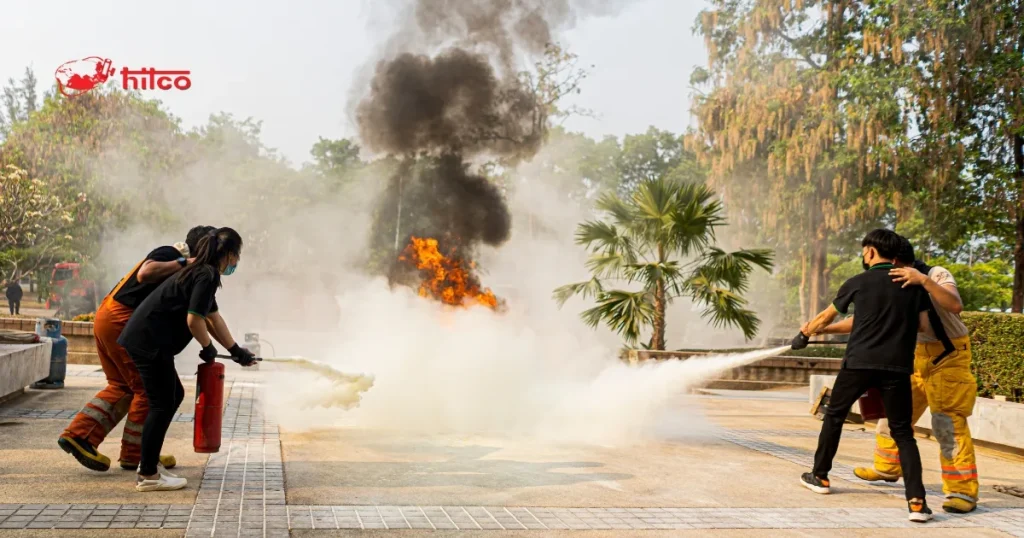
Nepal’s fire risk profile is genuinely serious. Kathmandu’s older commercial areas, Thamel, New Road, and Ason, are packed with aging structures, dense electrical networks, and buildings that weren’t designed with modern fire safety in mind.
The dry season between November and April brings elevated risk across the country, and industries like garment manufacturing, hospitality, and electronics retail face daily exposure to ignition hazards.
Reported fire incidents in Nepal have been consistently high in recent years, with significant losses in commercial properties, often traced back to electrical faults and improper storage. The Kathmandu Valley’s rapid commercial development has outpaced safety infrastructure in many areas.
That gap is exactly why training is so critical right now. Equipment alone isn’t enough if no one knows how to use it or respond properly.
How to Implement Fire Safety Training in Nepal?
Getting training right means thinking about who needs what and how to deliver it effectively.
- Target the right audience: Train everyone, but prioritize managers, HR teams, security staff, and fire wardens; they lead during emergencies and set the standard.
- Choose the right training format: On-site training works best for hands-on practice like extinguisher use and evacuation drills. Online sessions suit theory, while a hybrid approach balances both for larger teams.
- Set appropriate duration: Programs can range from 1-day intensive sessions to extended certification courses. High-risk sectors like factories, warehouses, and construction sites in Nepal benefit from more detailed, site-specific training.
- Train with real equipment: Conduct sessions in your actual workplace using your own fire safety equipment. Practical experience in a real setting makes training far more effective.
- Consider costs and investment: Basic training in Kathmandu typically ranges from NPR 1,500 to 9,800 per person, while advanced certifications can go up to NPR 40,000. International programs like NEBOSH are also available for larger organizations.
Conducting a Workplace Fire Risk Assessment

Before training, you need to know what you’re dealing with. A workplace fire risk assessment maps your specific vulnerabilities.
Walk every floor. Identify ignition sources: electrical panels, kitchen equipment, and machinery. Map fuel sources, stored materials, furniture, and paper. Check suppression systems and alarm coverage. Note blocked or poorly marked exits.
For industrial settings, map high-voltage zones, chemical storage, and high-traffic movement areas separately. For offices, focus on electrical load, server rooms, and floor-by-floor evacuation flow.
Document everything. That assessment becomes your training brief and your legal record.
How Does Hitco Support Fire Safety?
Hitco has built its reputation in Nepal by understanding what businesses actually do—not just selling equipment but helping organizations build complete fire safety systems.
Our product range covers the full spectrum: fire extinguishers suited to different environments (ABC, CO2, and wet chemical), alarm and detection systems, and suppression solutions for higher-risk settings. For industrial fire safety in Nepal, Hitco’s experience across manufacturing and commercial sectors is particularly relevant.
What sets us apart is the combination of supply, installation, and ongoing support. A CO₂ extinguisher mounted in the wrong location, or a detector installed without proper calibration, isn’t going to protect anyone. Hitco’s team ensures equipment is correctly placed and provides professional fire extinguisher maintenance in Nepal to ensure readiness.
Training and equipment work best together. Your staff learns the PASS method, and the extinguisher they practice with is properly maintained and ready. That alignment is what real fire preparedness looks like.
-
 Quick View
 -
 Quick View
 -
 Quick View
 -
 Quick View
 -
 Quick View
 -
 Quick View
 -
 Quick View
 -
 Quick View
Final Thoughts
Fire safety in Nepal isn’t complicated. It’s just consistently underestimated.
Most businesses wait until they’ve had a close call or until a labor inspection forces their hand. By that point, they’ve already accepted unnecessary risk and sometimes paid for it.
The good news is that getting this right isn’t expensive or difficult. A solid training program, the right equipment from a trusted supplier like Hitco, and a couple of evacuation drills a year will put you ahead of most businesses operating in Kathmandu today.
At the end of the day, fire safety is just basic respect for your people. Train them properly. Equip your building correctly. And don’t wait for a reason to start.
If you are ready to secure your workplace with expert fire safety training in Nepal, reach out to our specialists today for a customized training plan.
FAQ's
What is fire safety training?
Fire safety training teaches employees how to prevent, detect, and respond to workplace fire hazards. It includes using fire extinguishers, understanding evacuation procedures, and following emergency protocols to keep everyone safe.
Why is fire safety training important for businesses?
It protects lives, reduces property damage, ensures compliance with laws like the Nepal Labour Act 2074, and helps employees respond quickly and effectively during emergencies.
Is fire safety training legally required in Nepal?
Yes. Under the Nepal Labour Act 2074, employers must provide a safe working environment and proper safety training. Companies with 20+ employees must also form a health and safety committee.
Who should undergo fire safety training?
All employees should receive basic training. Additionally, designated fire wardens and supervisors should undergo advanced training to lead evacuations and manage emergencies.
How often should fire safety training be conducted?
At least once a year. Regular refresher sessions and bi-annual fire drills are recommended, especially in high-risk workplaces or busy areas like Kathmandu.
What does fire safety training typically include?
Training usually covers:
- Fire prevention techniques
- Use of fire extinguishers (PASS method)
- Evacuation planning and drills
- Emergency response procedures
- Workplace-specific fire risks
What is the PASS method in fire safety?
PASS stands for:
- Pull the pin
- Aim at the base of the fire
- Squeeze the handle
- Sweep side to side
It’s the standard method for using fire extinguishers effectively.
Can fire safety training be conducted online?
Yes, theoretical parts can be done online. However, practical, on-site training is essential for hands-on experience with equipment and real evacuation routes.
What is the cost of fire safety training in Nepal?
Typical costs in 2026:
- Basic training: NPR 1,500 – 9,800
- Advanced certification: NPR 25,000 – 40,000
- International programs like NEBOSH: around USD 1,295
What does an ABC fire extinguisher cover?
ABC extinguishers handle:
- Class A: Wood, paper, cloth
- Class B: Flammable liquids (petrol, oil)
- Class C: Electrical fires
They are widely used in offices and commercial spaces across Nepal.
(For a full breakdown of all classes, see our guide on the five types of fire extinguishers)
Protect Your Business and Your People. From ABC extinguishers to advanced suppression systems, Hitco is Nepal’s most trusted fire safety partner.

