

According to the National Disaster Risk Reduction and Management Authority (NDRRMA), Nepal recorded 2,848 fire incidents in just nine months (July 2024–April 2025), resulting in 50 deaths, 404 injuries, and property losses exceeding Rs. 1.44 billion, and that’s just structural fires. Fire disasters are responsible for nearly 75% of all disaster-related economic losses in Nepal, far outpacing floods and landslides.
A fire extinguisher is one of the first safety products you should have to protect your home, office, vehicle, or business from becoming part of that statistic. But not all fire extinguishers are the same; different extinguishers are designed for different types of fires.
For example, an ABC dry powder extinguisher is suitable for most homes and offices, while CO₂ extinguishers are designed for electrical equipment, and wet chemical extinguishers are essential for commercial kitchens. Buying the wrong type may be ineffective or even make certain fires more dangerous.
This fire extinguisher buying guide in Nepal explains everything you need to know before purchasing a fire extinguisher in Nepal. You’ll learn about the different types available, their prices, recommended uses, fire classes, legal requirements, maintenance, and the key factors to consider before making your purchase.
Emergency Contact for Fire Safety in Nepal:
Nepal Fire Brigade (National): 101
Nepal Police Emergency: 100
Ambulance Service: 102
Quick Overview: Before You Buy a Fire Extinguisher in Nepal
If you’re looking for a quick answer, here’s what you need to know before buying a fire extinguisher in Nepal.
Buying Factor | Recommendation |
Best type for most homes | ABC Dry Powder (2–4 kg) |
Best for offices | ABC Dry Powder + CO₂ |
Best for electrical fires | CO₂ Fire Extinguisher |
Best for restaurants/kitchens | Wet Chemical + CO₂ |
Best for factories/warehouses | ABC Dry Powder or Mechanical Foam (9 kg+) |
Vehicle use | 1–2 kg ABC Dry Powder |
Typical price range | NPR 1,500 – 12,250+ |
Legal requirement | Mandatory in all commercial, hotel, hospital, school, and factory buildings under Nepal’s fire safety codes |
Recommended brands | Ceasefire, SafePro, SRI, AGNI, NewAge |
What to check before buying | Fire class, ISI/CE certification, capacity, pressure gauge, warranty, refill service |
Where to buy | Online or in-store from a certified fire safety supplier |
Maintenance | Monthly visual inspection · Annual professional servicing · Refill after any use |
This fire extinguisher buying guide in Nepal helps you understand these factors so you can choose the right extinguisher for your home, office, or business.
First, Know the Type of Fire Extinguishers You Need
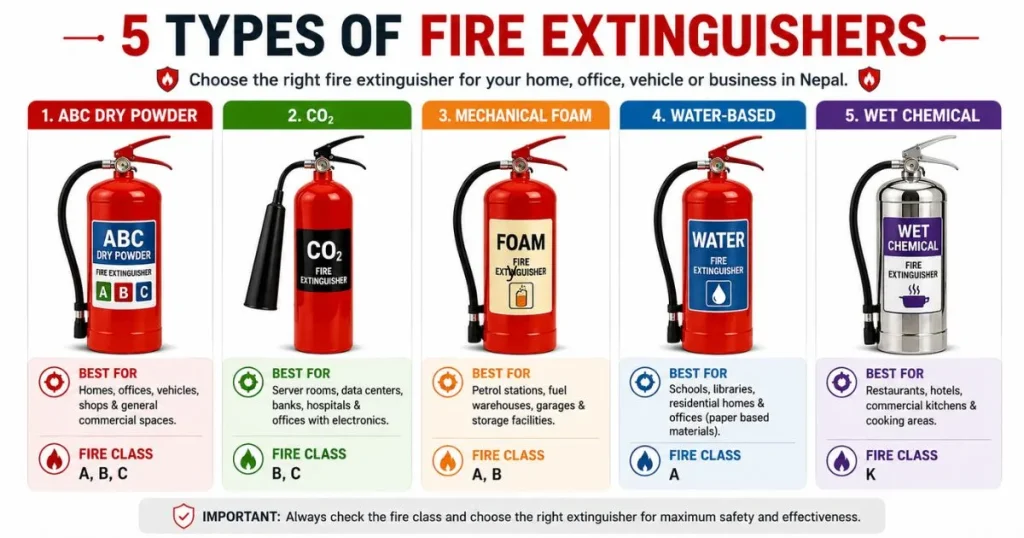
One of the most important steps in any fire extinguisher buying guide in Nepal is understanding that not all fire extinguishers work on every type of fire. Choosing the wrong type can make a fire worse or create a dangerous situation. Here are the five types of fire extinguisher available in Nepal and exactly what each one does.
1. ABC Dry Powder Fire Extinguisher
The most widely used fire extinguisher in Nepal. It contains monoammonium phosphate powder that smothers flames by interrupting the chemical chain reaction of fire.
Fire Classes: Class A (wood, paper, cloth) · Class B (petrol, kerosene) · Class C (electrical fires)
Best For: Homes, offices, vehicles, shops, and general commercial spaces in Nepal.
Pros | Cons |
Versatile handles three fire classes | Leaves powder residue, damages electronics |
Affordable and widely available | Not suitable for kitchen oil or grease fires |
Effective in open spaces | Reduces visibility when discharged |
Buy an ABC fire extinguisher here:
- Safepro ABC 1kg Fire Extinguisher: NPR 1,500
- Ceasefire ABC 2 kg Fire Extinguisher: NPR 2,800
- Ceasefire ABC 4kg Fire Extinguisher: NPR 6,000
- Ceasefire ABC 6kg Fire Extinguisher: NPR 7,000
- Safepro ABC 9kg Fire Extinguisher: NPR 4,200
2. CO₂ (Carbon Dioxide) Fire Extinguisher
Discharges carbon dioxide gas to displace oxygen and suffocate the fire. Leaves zero residue, ideal for electronics and sensitive equipment.
Fire Classes: Class B (flammable liquids) · Class C (electrical fires)
Best For: Server rooms, data centers, banks, hospitals, and offices with expensive electronics.
Pros | Cons |
No cleanup safe for electronics and documents | Does not work on Class A fires (wood, paper) |
Most effective on electrical fires | CO₂ gas is asphyxiating. Ventilate after use |
Zero chemical contamination | Higher cost than ABC powder |
Buy a CO₂ fire extinguisher here:
- SRI CO₂ 2kg Fire Extinguisher: NPR 7,000
- SRI CO₂ 5kg Fire Extinguisher: NPR 12,250
- Safepro CO₂ 2kg Fire Extinguisher: NPR 6,200
- Safepro CO₂ 4.5kg Fire Extinguisher: NPR 9,500
3. Mechanical Foam Fire Extinguisher
Creates a blanket of foam that seals the fuel surface and smothers the fire, preventing re-ignition.
Fire Classes: Class A · Class B (petrol, oil, diesel)
Best For: Petrol stations, fuel warehouses, industrial kitchens, garages, and storage facilities in Nepal.
Pros | Cons |
Excellent for liquid fuel fires | Messy to clean up |
Cools and seals the fire simultaneously | Not suitable for electrical fires |
Good for large surface liquid fires | Cannot be used on cooking oil or grease fires |
Buy a mechanical foam fire extinguisher here:
- SRI Mechanical Foam 6ltr Fire Extinguisher: NPR 6,050
- SRI Mechanical Foam 9ltr Fire Extinguisher: NPR 7,350
- Safepro Mechanical Foam 6ltr Fire Extinguisher: NPR 2,800
- Safepro Mechanical Foam 9ltr Fire Extinguisher: NPR 4,200
4. Water-Based Fire Extinguisher
Uses pressurized water to cool the burning material and remove the heat element of the fire triangle.
Fire Classes: Class A only (wood, paper, fabric, cardboard)
Best For: Schools, libraries, residential homes, and offices with predominantly paper-based materials.
Pros | Cons |
Environmentally safe | Cannot be used on electrical fires; serious risk |
Lowest cost option | Ineffective on liquid or grease fires |
Easy to use | Very limited versatility |
Price Range: NPR 2,000 – 4,500
5. Wet Chemical Fire Extinguisher
Specially designed for cooking fires. Sprays a fine mist of a potassium-based solution that cools burning oil and creates a soapy barrier to prevent re-ignition.
Fire Classes: Class K (cooking oils and fats) · Class A
Best For: Restaurants, hotels, commercial kitchens, and cloud kitchens anywhere large quantities of oil are heated in Nepal.
Pros | Cons |
The only type effective on cooking oil fires | Not suitable for general use |
Prevents re-ignition | Higher cost than standard extinguishers |
Safe to use near cooking surfaces | Limited availability in Nepal |
Price Range: NPR 5,000 – 12,000
Want to get the best fire extinguisher price in Nepal, don’t compromise on safety. Hitco offers the most competitive, transparent fire extinguisher price in nepal on certified equipment built for homes, offices, and industrial garages. Our inventory ranges from compact 1kg personal units starting at just NPR 1,500 up to specialized, residue-free CO₂ systems.
Comparison Table for Fire Extinguisher Prices in Nepal
Type | Fire Class | Best For | Price (NPR) |
ABC Dry Powder | A, B, C | Homes, offices, vehicles | 2,000 – 8,000 |
CO₂ | B, C | Server rooms, banks, hospitals | 7,000 – 12,250 |
Mechanical Foam | A, B | Petrol stations, warehouses | 6,050 – 7,350 |
Water-Based | A | Schools, libraries, homes | 2,000 – 4,500 |
Wet Chemical | A, K | Restaurants, hotels, kitchens | 5,000 – 12,000 |
Ready to buy the right fire extinguisher for your space? Hitco Nepal offers ABC, CO₂, and Mechanical Foam fire extinguishers in all sizes and price ranges, with delivery all over Nepal.
Fire Classes in Nepal: Which Extinguisher Fights Which Fire?
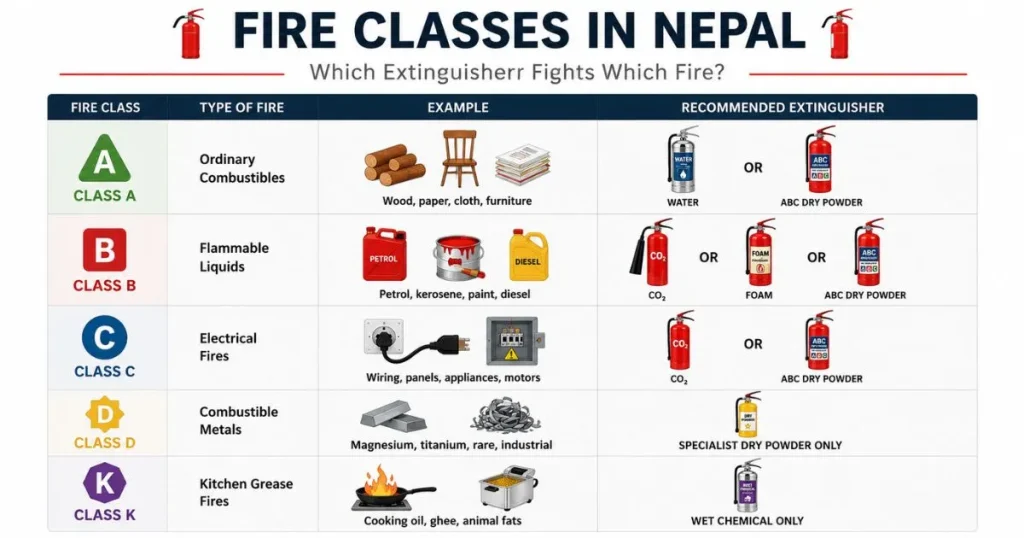
Understanding fire classes is the first step to choosing the right extinguisher. Using the wrong type can make a fire worse or create a dangerous situation.
Fire Class | Type of Fire | Example | Recommended Extinguisher |
Class A | Ordinary combustibles | Wood, paper, cloth, furniture | Water, ABC Powder, Foam |
Class B | Flammable liquids | Petrol, kerosene, paint, diesel | ABC Powder, CO₂, Foam |
Class C | Electrical fires | Wiring, panels, appliances, motors | CO₂, ABC Powder (NOT water) |
Class D | Combustible metals | Magnesium, titanium, rare, industrial | Specialist Dry Powder only |
Class K | Kitchen grease fires | Cooking oil, ghee, animal fats | Wet Chemical only |
What this means for Nepal specifically
Class A is the most common fire risk in Nepali homes. Wood-framed structures, furniture, and fabric are all Class A fuels, and an ABC or water-based extinguisher covers this.
Class C (electrical) is the leading cause of fire in Kathmandu Valley; as mentioned earlier, the majority of fire incidents in a single fiscal year were caused by electrical short circuits. A CO₂ extinguisher is essential for any home or office with aging wiring or a heavy electrical load.
Class K is critical for any commercial kitchen in Nepal. Restaurants, hotels, and food businesses heating large quantities of cooking oil must have a wet chemical extinguisher; no other type is effective on burning ghee or cooking oil.
How to Choose the Right Fire Extinguisher for Your Needs in Nepal
The right fire extinguisher depends on where you are, what fire risk that space carries, and how large the area is. A home kitchen has completely different risks from a factory floor or a hotel restaurant. Choosing the wrong type or the wrong size means it may not work when you need it most.
For Home
Most Nepali homes face fire risk from three sources: LPG gas stoves, electrical wiring, and wood or paper materials. A 2–4 kg ABC extinguisher covers all three effectively.
Keep one in the kitchen area and one near the main electrical panel. If your kitchen involves deep frying or large quantities of oil, add a small wet chemical extinguisher near the stove.
Recommended read: Fire Extinguisher for Home in Nepal
Product Recommendation:
-
 Quick View
 -
 Quick View
For Office / Commercial Building
ABC for general areas Nepal’s National Building Code mandates fire extinguishers in all commercial buildings. Place CO₂ units near electrical panels, server rooms, and UPS rooms. Use ABC extinguishers in corridors, reception, and open work areas. Every exit and stairwell should have one.
Recommended read: Fire Extinguisher for Commercial Use in Nepal
Product Recommendation:
-
 Quick View
 -
 Quick View
For Factory / Warehouse
Multiple units required Industrial settings carry higher fire loads, flammable liquids, heavy machinery, and large open floor areas. Multiple large-capacity extinguishers are required at regular intervals with clear floor markings and signage. Nepal’s Labor Act legally requires factories to maintain fire safety equipment.
Product Recommendation
-
 Quick View
 -
 Quick View
For Restaurant / Hotel
Commercial kitchens are one of the highest fire-risk environments in Nepal. A wet chemical extinguisher is non-negotiable near every cooking station. Add CO₂ near electrical panels and back-of-house equipment and ABC extinguishers in dining areas and lobby spaces.
Product Recommendation
-
 Quick View
For Vehicles
A compact 1–2 kg ABC extinguisher should be mounted in the cabin or boot of every vehicle. For commercial vehicles, trucks, buses, and public transport, this is a legal requirement under Nepal’s Vehicles and Transportation Management Act.
Product Recommendation:
-
 Quick View
For Schools / Hospitals
Schools and hospitals carry mixed fire risks: paper, wooden furniture, electrical systems, and sensitive medical equipment. Mount extinguishers at every floor landing and near exits. Hospitals should use CO₂ units near medical equipment to avoid powder contamination.
Recommended read: Fire Extinguisher for Schools in Nepal
Product Recommendation
-
 Quick View
What Size Fire Extinguisher Do I Need?
Size matters as much as type. An extinguisher too small will run out before the fire is out; too large will be difficult to handle in an emergency.
Use Case | Recommended Capacity |
Personal vehicles: cars, motorcycles | |
Homes and small apartments | |
Small offices and shops | |
Commercial buildings and restaurants | |
Factories, warehouses, industrial sites | 9 kg and above |
A larger capacity means longer discharge time and greater coverage area. When in doubt, size up; it is always better to have more capacity than you need than not enough.
What to Check Before Buying a Fire Extinguisher in Nepal
Before buying a fire extinguisher in Nepal, check six things: fire class, certification, capacity, manufacturing date, pressure gauge, and warranty/after-sales support. Getting these right matters more than price. A cheaper unit that’s the wrong fire class or lacks certification may not protect you when it counts.
- Fire Class: Match the extinguisher to your fire risk class A, B, C, or K. See the Fire Classes section above for which class applies to your space.
- Certification: Look for ISI or CE certification. Certified units are tested for performance and safety; uncertified ones may fail when you need them most.
- Capacity: Match capacity to area size: 1–2 kg for vehicles up to 9 kg+ for factories. See the Size Guide section above for the full breakdown.
- Manufacturing Date: Check the cylinder’s manufacturing date and confirm it’s within its service period. An old, unserviced unit may already be under-pressurized before installation.
- Pressure Gauge: The needle should sit in the green zone before purchase. A gauge outside range even on a new-looking unit means it needs servicing first.
- Warranty & After-Sales Support: Confirm the supplier offers warranty, refilling, annual maintenance, spare parts, and technical support so the unit stays functional for its full service life.
Getting these six checks right before you buy is what separates an extinguisher that actually works in an emergency from one that just sits on the wall for show.
Fire Extinguisher Rules and Regulations in Nepal
Fire extinguishers are not optional in Nepal; they are a legal requirement for most commercial, public, and industrial buildings. Here is what the law says and what it means for you.
Is It Mandatory to Have a Fire Extinguisher in Nepal?
Yes. Nepal’s law requires fire extinguishers across most building types, vehicles, and workplaces. Here is what applies to you:
- Nepal National Building Code (NBC): All commercial, industrial, and public buildings must have portable fire extinguishers at accessible locations. Buildings above a certain size must also have a full fire safety plan.
- Nepal Fire Service Act: Hotels, hospitals, schools, factories, shopping complexes, cinemas, and restaurants are all legally required to have fire extinguishers. Kathmandu Valley municipalities now require a fire safety certificate as part of the building permit process.
- Labor Act 2017 : All employers must provide fire safety equipment in every factory and workplace as part of a safe working environment.
- Vehicles and Transportation Management Act: All commercial vehicles must carry a functional fire extinguisher at all times.
- Inspection Requirements: Professional servicing is required at least once a year. After any discharge, the unit must be refilled before returning to service.
- Penalties for Non-Compliance: Fines, closure orders, personal liability in the event of a fire, and possible denial of insurance claims.
For exact requirements specific to your building type and municipality, consult your local municipality office or the Nepal Fire Service. Requirements vary by province and building use.
How to Use a Fire Extinguisher: The PASS Method
If a fire starts and it is small and contained, act immediately. Every second counts; therefore, to use a fire extinguisher follow the PASS method:
- P: Pull the pin. Break the tamper seal and pull the safety pin from the handle. This unlocks the operating lever.
- A: Aim low. Point the nozzle or hose at the base of the fire, not at the flames. The base is where the fuel is; that is what you need to hit.
- S: Squeeze the handle. Press the lever above the handle firmly and evenly to discharge the extinguishing agent.
- S: Sweep side to side. Move the nozzle in a slow, steady side-to-side motion across the base of the fire until it is fully extinguished. Watch for re-ignition and repeat if necessary.
Safety Tip: Never test a fire extinguisher by spraying it for practice. Even a brief discharge reduces its effectiveness and usually requires professional refilling before it can be safely used again.
How to Maintain and Refill Fire Extinguishers in Nepal?
A fire extinguisher is only useful if it works when you need it. Regular maintenance is not optional; it is what stands between you and a failed response in an emergency.
Monthly Visual Inspection Do-It-Yourself
Take two minutes every month to check the following:
- Check the pressure gauge; the needle should be in the green zone
- Inspect for visible damage: dents, rust, corrosion, or leaks
- Ensure the safety pin is in place and the tamper seal is intact
- Confirm the extinguisher is accessible and clearly visible, not blocked by furniture or boxes
Annual Professional Service
Nepal fire safety standards require a professional inspection at least once per year. A trained technician will test the pressure, inspect internal components, check the hose and nozzle, and issue a service tag. Do not skip this; an uninspected extinguisher may fail to discharge when you need it most.
When to Refill
- Immediately after any use even a brief discharge
- Every 3–5 years for CO₂ extinguishers, hydrostatic pressure testing required
- As per the manufacturer’s schedule on the service label
Signs Your Extinguisher Needs Replacement
Do not wait for an emergency to discover your extinguisher is faulty. Replace it immediately if you notice any of the following:
- Pressure gauge in the red zone: over- or under-pressurized
- Cracked, clogged, or damaged nozzle or hose
- Visible rust, corrosion, or severe dents on the cylinder
- Missing or broken safety pin
- The service tag shows it is overdue for inspection
Hitco Nepal provides professional fire extinguisher maintenance and refilling services for all extinguisher types across Nepal. Annual servicing, pressure testing, and same-unit refilling are available.
How to Buy a Fire Extinguisher in Nepal?
To buy a fire extinguisher in Nepal, identify your fire risk, choose the correct extinguisher type and size, verify ISI or CE certification, and purchase from a certified supplier offering installation and servicing. Here are the steps you can follow to buy a fire extinguisher in Nepal:
Step 1: Identify your fire risk. Determine whether your space is prone to Class A (wood, paper), Class B (fuel, gas), or Class C (electrical) fires. Homes and offices usually face a mix of all three.
Step 2: Choose the right type. Pick an ABC dry powder extinguisher for general use, or a CO₂ extinguisher if you have server rooms, electronics, or heavy electrical equipment.
Step 3: Pick the correct size. Match the capacity to your space: 1–2 kg for vehicles, 2–4 kg for homes, and 6 kg or more for offices, restaurants, or commercial buildings.
Step 4: Check certification and pressure. Confirm the unit is ISI or CE certified and the pressure gauge needle sits in the green zone before purchase.
Step 5: Buy from a trusted supplier. Purchase online or in-store from a certified fire safety supplier that offers installation, warranty, and after-sales support like refilling and annual servicing.
Step 6: Install and maintain. Mount the extinguisher in an accessible, visible location and schedule monthly visual checks along with annual professional servicing.
In short, knowing your fire risk, picking the right type and size, checking certification, and buying from a trusted supplier are all it takes to get fully protected. Get this right once, and your fire extinguisher will be ready to work when it matters most.
Buying Tip: If you’re unsure which extinguisher is right for your property, choose an ABC dry powder extinguisher. It protects against the most common fire risks found in Nepali homes, offices, and vehicles.
Choose Hitco to Purchase Fire Extinguisher in Nepal
When it comes to fire safety, you need a supplier you can trust not just for the product but also for the knowledge and after-sales support that come with it.
- Established in 1975: over 50 years of fire safety expertise in Nepal
- Authorized distributor of leading brands: Ceasefire, Safe Pro, SRI, AGNI, NewAge, and more.
- 20+ fire extinguisher products across all types and capacities
- Delivery all over Nepal: from Kathmandu to Pokhara, Biratnagar to Butwal
- 24/7 customer support: +977 985-1253028
- Flexible payment options: Cash on Delivery, Online Payment, and Payment After Installation
- Physical store: Kapan Marg, Maharajgunj, Kathmandu
Fire safety is too important to compromise on. Hitco Nepal has been the trusted choice for homes, offices, restaurants, factories, and institutions across Nepal for over five decades, and we back every product with the service and support you need to stay compliant and protected.
Ready to buy fire extinguisher? Get the right fire extinguisher delivered anywhere in Nepal. Browse our full range at hitco.com.np
Final Thoughts
Buying the right fire extinguisher in Nepal comes down to three things: the right type for your fire risk, the right size for your space, and a reliable brand backed by proper service and certification.
With fire incidents claiming lives and billions in property every year across Nepal, fire safety is not a luxury; it is a necessity. Whether you are protecting a home, a restaurant, a hospital, or a vehicle, the right extinguisher, properly maintained, can be the difference between a minor incident and a total loss.
We hope this fire extinguisher buying guide in Nepal has helped you understand how to choose the right extinguisher based on your property, fire risks, and legal requirements.
Do not wait for a fire to realize you were not prepared.
Ready to protect your home, office, or business in Nepal? Get expert advice, find the right extinguisher for your space, and place your order all in one place. Contact Us Today
FAQs
Which fire extinguisher is best for home use in Nepal?
An ABC dry powder extinguisher with 2–4 kg capacity is the best choice for most Nepali homes. It covers LPG gas stoves, electrical wiring, and wood or paper fires all in one unit.
What is the price of a fire extinguisher in Nepal?
Prices range from NPR 2,000 for a small ABC unit to NPR 12,250 for a 5 kg CO₂ extinguisher. The final price depends on the type, capacity, and brand.
Which fire extinguisher is best for electrical fires in Nepal?
A CO₂ extinguisher is the best choice; it leaves no residue and does not conduct electricity. Never use a water-based extinguisher near electrical sources.
Is it mandatory to have a fire extinguisher in Nepal?
Yes. Nepal’s National Building Code and municipal regulations legally require fire extinguishers in all commercial, industrial, hotel, hospital, school, and factory buildings.
How long does a fire extinguisher last?
A fire extinguisher typically lasts 5 to 12 years depending on type and maintenance. Annual professional servicing and refilling after any use are required.
How often should a fire extinguisher be serviced in Nepal?
Professional servicing is required at least once a year. A monthly visual check of the pressure gauge, pin, and seal is also recommended.
Where can I buy a fire extinguisher in Nepal?
You can buy online at hitco.com.np or visit our store at Kapan Marg, Maharajgunj, Kathmandu. Hitco delivers across Nepal with cash on delivery and online payment options.

