

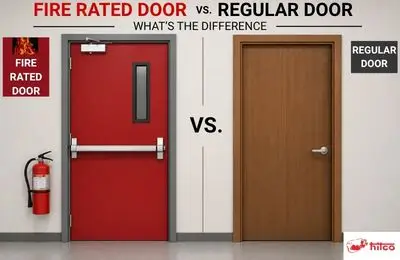
A fire rated door and a regular door can be sitting side by side and look identical. The difference only shows up when there’s an actual fire, and by then it’s too late to find out the hard way.
Fire Rated Doors vs. Regular Doors comes down to one thing: testing and certification. A fire rated door is built and tested to resist fire and smoke for a set number of minutes. A regular door isn’t tested for fire at all; it’s built for privacy and everyday use. This matters most in hotels, offices, factories, hospitals, and apartment buildings in Nepal, where the wrong door in the wrong spot can cost precious evacuation time.
Here’s how the two actually compare and where each one belongs.
At a Glance: Fire Rated Doors vs Regular Doors
Aspect | Fire Rated Door | Regular Door |
Testing | Lab-tested and certified (FD30 to FD120) | No testing or certification |
Construction | Fire-resistant core, matching frame, rated hardware, seals | Standard materials, no seals or fire-rated hardware |
Where Required | Stairwells, exits, corridors, hotels, factories, hospitals | Bedrooms, offices, other low-risk interior spaces |
Cost in Nepal (single leaf) | NPR 57,000 – 90,000+ | NPR 5,000 – 35,000 |
Bottom Line | Use where evacuation time and fire containment matter | Use where fire compartmentation isn’t required |
Need Reliable Fire Protection for Your Building? Protect critical areas with HITCO’s Fire Resistant Door, designed to provide 60 minutes of fire protection at 900°C. Suitable for commercial, industrial, and residential applications.
What Are Fire Rated Doors and Regular Doors?
A “fire rated” door and a “fire resistant” door aren’t always sold with the same meaning behind them, and that gap is exactly where buyers get misled. Before comparing the two properly, here’s what each one actually is.
What Is a Fire Rated Door?
A fire rated door is a door that’s been tested in a lab under real fire conditions and rated for how long it can resist flames, heat, and smoke before it fails, usually shown as a time value like 30, 60, 90, or 120 minutes.
That rating doesn’t apply to the door leaf alone. It applies to the whole door as a tested assembly, so if any part gets swapped for something non-rated later, the door technically loses its certification.
This is where a lot of confusion comes from. A door doesn’t become fire rated just because it’s heavy or solid-looking. Fire resistance is a tested, certified property, not something you can judge by weight or appearance.
What Is a Regular Door?
A regular door is built for the job doors normally do: privacy, security, and separating spaces. Wooden panel doors, flush doors, glass doors, and aluminium doors all fall under this category.
None of these are tested or built specifically to resist fire. A plain wooden panel door, for example, might hold up for a few minutes in a small fire simply because of its thickness, but that’s coincidence, not a rated performance. There’s no lab result behind it, and no two doors of the same type will behave exactly the same way.
That’s really the core issue with regular doors in a fire. It’s not that they’re badly made, it’s that nobody has ever tested how they perform under fire, so there’s nothing to rely on when it actually counts.
Fire Rated Doors vs. Regular Doors: Key Differences
The two doors aren’t different because of one single feature; it’s a combination of things working together or, in a regular door’s case, not present at all. Here’s where they actually diverge, point by point.
Fire Resistance and Rating
This is the difference that actually decides what happens in a real fire. A fire rated door is engineered to resist flames and hold its structure for a defined period, tested and certified, not estimated.
Fire Door Rating Explained simply: the number tells you how many minutes the door can hold back fire under test conditions. FD30 FD60 FD90 FD120 Doors are the common classifications, FD30 giving 30 minutes of protection, FD60 giving 60 minutes, and so on up to FD120 for higher-risk areas.
A regular door has no such rating. Depending on the material, it might slow a fire down slightly, or it might not. Since it was never tested, there’s no way to know, and that’s the actual problem, not the lack of a number, but the lack of any real answer.
Smoke Protection
Fire rated doors come fitted with intumescent seals around the edges. These seals expand when heated and close the gap between the door and frame, cutting down how much smoke passes through. Many also include separate smoke seals for extra protection, and in larger buildings, this usually works alongside a proper smoke detection and fire alarm system rather than replacing one.
Regular doors typically skip this entirely. Gaps around the frame stay open, and smoke moves through them freely. In most fire incidents, smoke causes more harm and confusion than the flames themselves, which makes this one of the more underrated differences between the two.
Core Material and Construction
Fire Door Core Material is what actually gives these doors their resistance. Common cores include gypsum board, mineral wool, or specially treated timber. Some heavy-duty industrial fire doors use steel construction for even higher protection levels.
Regular doors are usually built with hollow cores, particleboard, plain solid wood, or glass, chosen for looks, weight, and cost rather than heat resistance. None of these materials are designed to hold up under sustained fire exposure, and that’s not a flaw, it’s just not what they were built for.
Door Frame Requirements
A fire rated door is only as good as the frame it sits in. A Fire Rated Door Frame is tested and rated to match the door itself, and swapping in a standard frame effectively cancels out the door’s certification, even if the door leaf is fully rated on its own.
Regular doors use standard frames, with no requirement for them to match or perform under heat. Any frame works, since there’s no fire rating to maintain in the first place.
Hardware and Self-Closing Mechanism
Fire doors need fire-rated hinges, locks, and closers, hardware built to hold up under heat rather than warp or fail. A Self-Closing Fire Door mechanism is also standard, since a fire door left propped open during a fire defeats the entire point of having one.
Regular doors use standard hardware, and there’s no requirement for a self-closing mechanism. Many are designed to be left open for convenience, which is the opposite of what a fire door needs to do.
Certification and Compliance
A fire rated door should carry a label, plug, or documentation confirming its rating and the standard it was tested against. Without that paperwork, there’s no real way to confirm a door performs the way it’s claimed to. This is also where fire doors connect to the bigger picture, they’re one requirement within a building’s overall fire safety plan, not a standalone checkbox.
Regular doors have no certification requirement, because there’s nothing to certify in the first place. This also means regular doors can’t be used in spaces where local fire codes or building compliance call for a rated door, no matter how solid the door looks or feels.
Everyday Practicality
Outside of a fire scenario, regular doors generally win on everyday practicality. They’re lighter, easier to install, cheaper to replace, and available in far more styles and finishes, which makes them the better fit for bedrooms, offices, and general interior spaces.
Fire rated doors are heavier and more rigid by design, which can make them feel less convenient for daily use. Some also come with limited style options, since the priority is performance, not appearance. That trade-off is worth it in the areas that need it, but it’s also why fire doors aren’t used everywhere in a building.
Quick Comparison Table
Feature | Fire Rated Door | Regular Door |
Fire Resistance | Tested and rated (FD30, FD60, FD90, FD120) | No fire testing or rating |
Smoke Protection | Intumescent and smoke seals fitted | Usually no smoke seals |
Core Material | Gypsum, mineral wool, steel, or fire-treated timber | Hollow core, particleboard, plain wood, glass |
Frame | Must be a matching fire-rated frame | Standard frame, any material |
Hardware | Fire-rated hinges, closers, and locks | Standard hardware |
Closing Mechanism | Self-closing device required | Optional, often left open |
Certification | Labeled and documented | No certification needed |
Everyday Use | Heavier, fewer style options | Lighter, more style and finish options |
Cost | Higher, due to testing and materials | Lower |
How Do Fire Rated Doors and Regular Doors Perform During a Fire?
Ratings and specs tell you what a door is designed to do. Here’s what that actually looks like once a fire is real and running.
What Happens to a Fire Rated Door?
Here’s roughly how it plays out once the heat hits, from the first few minutes to the point the rating runs out.
- Seals expand almost immediately and press into the doorframe gap, blocking smoke early
- Core material absorbs heat instead of transferring it through to the other side
- The door leaf holds its shape, with no warping or buckling
- Self-closing mechanism keeps it shut without anyone having to act
- Holds the line for its full rated time, 30, 60, or 90 minutes, buying evacuation time
What Happens to a Regular Door?
With no rating or tested components behind it, a regular door’s response comes down to chance more than design.
- No seals, no tested core, so behavior depends purely on material and distance from the fire
- Hollow-core doors weaken within minutes, with little material to absorb heat
- Gaps stay open throughout, letting smoke through early, often before flames arrive
- Solid wood may hold slightly longer, but only by chance, not by design
- No guaranteed failure point, which makes performance unpredictable when it matters most
Where Are Fire Rated Doors and Regular Doors Used?
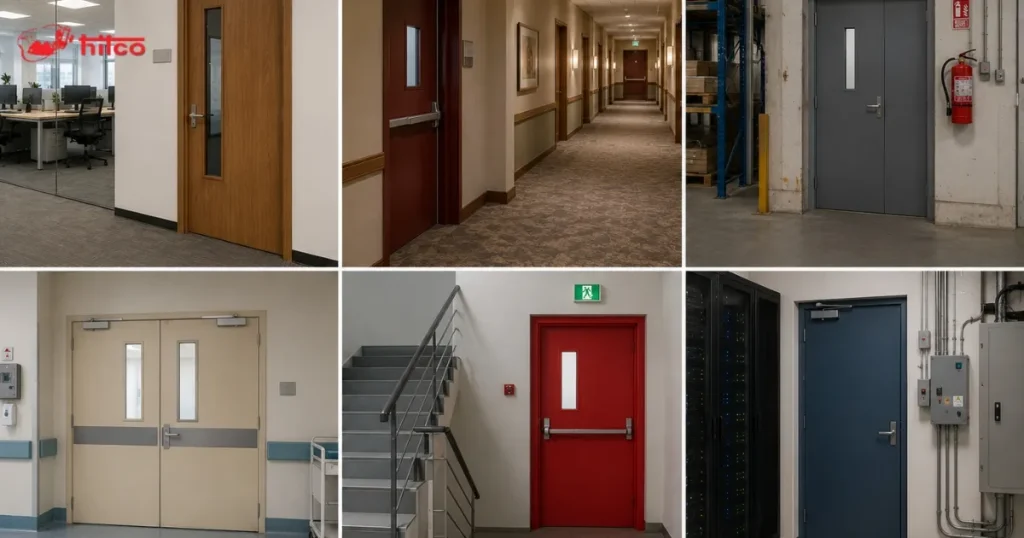
Where a door goes matters as much as what it’s made of. Some spaces need the protection a fire rated door provides, others don’t, and installing the wrong one in the wrong spot either wastes money or creates a real risk.
Where Are Fire Rated Doors Required?
Fire rated doors are expected anywhere a fire needs to be contained or an escape route needs to stay clear long enough for people to get out safely.
- Commercial buildings: offices, retail spaces, and mixed-use buildings with fire compartmentation requirements
- Hotels and apartments: guest corridors, stairwells, and common escape routes
- Factories and warehouses: areas with flammable materials, machinery, or higher fire risk
- Hospitals and healthcare buildings: patient areas and corridors where evacuation takes longer
- Stairways, corridors, and exit routes: the core escape paths in any multi-story building
- Server rooms and electrical panel rooms: spaces where an electrical fire risk needs to be contained
- A well-placed fire door also works best as part of a bigger plan, worth pairing this with a proper emergency escape plan so people know exactly where those exits lead.
Recommended Read: where to install fire rated doors in buildings.
Recommended Fire-Rated Door:
-

 Quick View
Where Are Regular Doors Suitable?
Regular doors work fine anywhere fire compartmentation isn’t part of the building’s safety plan, mostly low-risk, everyday spaces.
- Residential bedrooms and living spaces: no fire compartmentation requirement in typical homes
- Individual offices and cabins: standard interior rooms within a larger building
- Storage closets and low-traffic rooms: spaces with minimal fire risk or occupancy
- General interior partitions: rooms used purely for privacy or separation, not safety
Not sure which category your building falls into? Explore Hitco’s full range of fire safety solutions to find the right setup for your space.
Fire Rated Doors vs. Regular Doors: Price Difference in Nepal
Fire Rated Door Cost in Nepal run significantly higher than a regular door, and once you break down what’s included, the price gap makes sense.
Price Comparison Table:
Feature | Regular Doors (Interior / Entrance) | Fire-Rated Doors (Certified 60–120 Min) |
Material Options | PVC, flush ply, softwood, solid hardwood, standard steel | Galvanized iron (GI) steel, stainless steel, fire-treated hardwood |
Average Cost (per unit) | NPR 5,000 – NPR 35,000 | NPR 57,000 – NPR 90,000 (single leaf) |
Double Leaf / Wide Exits | NPR 35,000 – NPR 60,000 | NPR 1,20,000 – NPR 1,90,000+ |
Per Sq. Ft. Estimation | NPR 150 – NPR 500 / sq. ft. | NPR 1,750 – NPR 2,200 / sq. ft. |
Hardware / Accessories | Standard hinges, knobs, mortise locks | Fire-rated panic bars, vision panels (fire glass), door closers |
For an honest Fire Door Price Comparison Nepal, ask suppliers to break the quote into door, frame, hardware, and installation separately rather than one bundled number. This makes it easier to spot if a “fire rated” quote is actually missing a certified frame or hardware. For projects in Nepal, it is also worth checking the Nepal National Building Code NBC 107: Provisional Recommendation on Fire Safety, published by Nepal’s Department of Urban Development and Building Construction (DUDBC), for the applicable fire-safety provisions.
When comparing Fire Door Suppliers in Nepal, the cheapest quote isn’t always the safest one. A supplier who can show documentation, explain the rating, and confirm the frame and hardware match the door is worth paying a bit more for than one who can’t.
Final Thoughts
A fire rated door and a regular door can look nearly identical, but they’re built for completely different jobs. One is designed for everyday privacy and access. The other is designed to buy people time when something goes seriously wrong.
If you’re specifying doors for a commercial project, hotel, factory, or apartment building in Nepal, treat the fire rating as non-negotiable for stairwells, exits, and high-risk areas. Confirm the frame and hardware match the door’s rating, ask for documentation, and make sure installation is done right; a fire door with the wrong gaps won’t perform the way it’s supposed to.
For everything else, a regular door does the job fine; there’s no need to overspend on ratings you don’t actually need. The real question is simple: what’s on the other side of this door, and how much time would people need if there was a fire here?
Not sure which rating fits your project? Get in touch with our team and we’ll help you figure out the right door, rating, and setup for your building.
Frequently Asked Questions
What is the difference between a fire rated door and a regular door?
A fire rated door is tested and certified to resist fire and smoke for a set period of time. A regular door has no fire rating and isn’t built or tested for fire resistance at all.
Are fire rated doors better than regular doors?
Not universally better, just built for a different purpose. Fire rated doors are essential in high-risk or escape areas, while regular doors are the practical, cost-effective choice for everyday interior spaces.
Can a regular door be used as a fire door?
No. Fire rating applies to the entire door assembly, including the frame, seals, and hardware tested together. Adding a closer or seal to a regular door doesn’t make it fire rated.
How long does a fire rated door resist fire?
It depends on the rating. Common ratings include FD30, FD60, FD90, and FD120, meaning 30 to 120 minutes of tested fire resistance before the door fails.
Are fire rated doors required in commercial buildings in Nepal?
Yes, especially in stairwells, exit routes, and high-risk areas of hotels, offices, hospitals, and factories, as part of meeting Nepal’s building fire safety requirements.
Are fire rated doors more expensive than regular doors?
Yes, noticeably. The cost comes from certified core materials, a matching fire-rated frame, tested hardware, and precise installation, all of which add up compared to a standard door.
Do fire rated doors need regular maintenance?
Yes. Seals, hinges, and the self-closing mechanism should be checked periodically, since damaged or painted-over seals and a door that doesn’t close fully can reduce its fire performance.

