

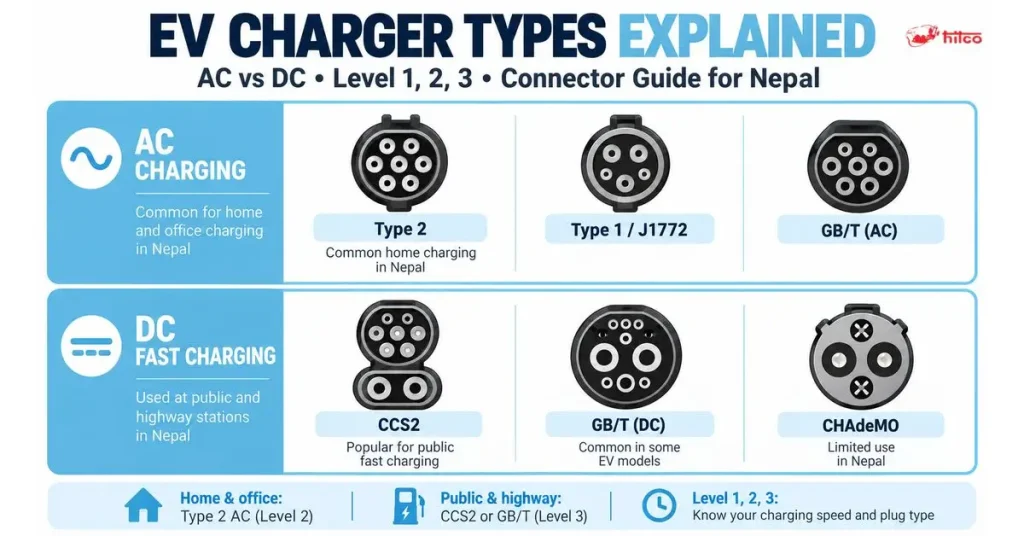
EV charger types are grouped in three ways: by current (AC or DC), by power level (Level 1, 2, or 3), and by connector (Type 2, CCS2, GB/T, and others). If you are buying your first electric vehicle in Nepal, these labels can look confusing, but they simply describe how fast your car charges and which plug it needs. In Nepal, most home and office charging uses AC with a Type 2 plug, while DC fast charging is mostly found at public and highway stations.
At HITCO, we supply Exicom AC chargers to Nepali EV owners, so this guide is written around local conditions. It covers how AC and DC charging differ, what each charging level means on Nepal’s 230V supply, which connector your EV uses, and how to choose a safe home EV charger for your parking setup and budget.
EV Charger Types in Nepal: Quick Summary
- Level 1 (AC, 120V outlet): the slowest option and not standard on Nepal’s 230V supply.
- Level 2 (AC): the everyday choice for homes and offices, about 3.3 kW to 22 kW, usually with a Type 2 plug.
- Level 3 (DC fast charging): used at public and highway stations, commonly 30 kW to 60 kW, with CCS2 or GB/T plugs.
- Cost: a home AC charger is about NPR 30,000 to 65,000 plus installation, while DC chargers start from about NPR 5,00,000 to 23,00,000.
- Before you buy: check your EV’s AC connector, its onboard charger limit, and whether your property’s wiring can support the charger.
What Are the Two Main Types of EV Charging? (AC vs DC)
The two main types of EV charging are AC and DC. AC charging sends alternating current to the car, where the onboard charger converts it into DC for the battery. DC charging converts the power inside the charger, so electricity goes straight into the battery at much higher speeds.
Feature | AC Charging | DC Charging |
Power type | Alternating current | Direct current |
Conversion | Done by the car’s onboard charger | Done by the charger before power reaches the battery |
Typical speed | Slow to moderate (about 3.3 to 22 kW) | Fast (such as 60 kW and above) |
Common location | Homes, offices, apartments | Public and highway stations |
Installation | Generally simpler | More complex |
Typical use | Overnight or daily charging | Long trips and quick top-ups |
Cost | About NPR 30,000 to 65,000 for a home charger, plus installation | About NPR 5,00,000 to over NPR 23,00,000 depending on power rating and brand |
AC is the practical choice for daily charging because it does not need high-power infrastructure. Your actual charging speed depends on both the charger’s output and your car’s maximum AC charging rate, which is why portable and wall-mounted AC EV chargers are the usual choice for homes and offices.
DC fast charging suits drivers who need a quick top-up rather than several hours of charging, which is why you find it at public stations, highways, and dealerships. It is generally not used for home installations because of its power and infrastructure needs.
Looking for a home EV charger in Nepal? Check the latest EV charger price in Nepal for HITCO’s Type 2 AC chargers and find one that fits your car and parking setup.
Level 1, Level 2, and Level 3 EV Charging Explained
Level 1 is slow AC charging from a standard household outlet, Level 2 is higher-power AC charging, and Level 3 is DC fast charging. These levels come from North America, so they do not map neatly onto Nepal’s supply.
Level | Current | Typical power | Relevance in Nepal |
Level 1 | AC (120V outlet) | Low, around 1 to 2 kW | Not standard on Nepal’s 230V supply |
Level 2 | AC | About 3.3 kW to 22 kW | Main option for home and office charging |
Level 3 | DC | 30 kW and above | Public and highway fast charging |
Level 1: Slow Charging
Level 1 is the slowest charging category and uses a standard 120V household outlet, mainly in North America. Nepal’s homes run on 230V, so you will rarely see it here. The closest local equivalent is a 3.3 kW portable charger, which is better described as entry-level AC charging.
Level 2: Standard AC Charging
Level 2 is the main choice for home and office charging in Nepal, with outputs from about 3.3 kW to 22 kW. Single-phase supply covers most homes and typically supports a 3.3 kW EV charger, which adds roughly 15 to 20 km of range per hour, or a 7.4 kW EV charger (7.2 to 7.4 kW), which adds roughly 30 to 45 km per hour.
Three-phase supply supports 11 kW or 22 kW for offices, apartments, and commercial buildings when both the property and the vehicle support it.
Your car’s onboard charger sets the maximum AC rate, so a 22 kW charger will not charge every EV at 22 kW. If you only need overnight top-ups, a portable 3.3 kW charger is a practical starting point.
Level 3: DC Fast Charging
Level 3 charges much faster than any AC option, and Nepal’s public stations commonly offer 30 kW to 60 kW, with some higher. Depending on the vehicle, charger power, battery temperature, and state of charge, some high-power systems can reach around 80% in roughly 15 to 30 minutes.
For example, Tata’s Nepal specifications list a 60 kW DC option for the Nexon EV, with a manufacturer-stated 10% to 80% charge in about 40 minutes on the specified version. Actual times vary by vehicle and charger.
EV Charging Connector Types: Which Plug Does Your EV Use?
Most AC charging in Nepal uses a Type 2 connector, while DC fast charging commonly uses CCS2 or GB/T. Your EV’s charging inlet decides which plug you need, so check it before buying any charger. A charging level describes how electricity is delivered, while the connector is the physical plug.
Connector | Charging Type | Common Region | Seen in Nepal? |
Type 2 | AC | Europe and many international markets | Yes, the main AC plug |
Type 1 (J1772) | AC | North America, Japan, older models | Limited |
CCS2 | DC + Type 2 AC | Europe and many international markets | Yes, widely used for DC |
CHAdeMO | DC | Japan and older EVs | Limited |
GB/T | AC and DC (separate plugs) | China | Yes |
NACS | AC and DC | North America (Tesla) | Rare |
Nepal’s government EV-charging master plan lists Type 2 AC, CCS2, GB/T, and CHAdeMO among the standards used or specified for the country, although CHAdeMO is limited in practice.
For home and office charging, most owners need a Type 2 charger, such as the Exicom EV chargers HITCO supplies. Some EVs, especially certain Chinese models, use a GB/T inlet instead, so confirm yours first.
What Is Type 1 and Type 2 EV Charging?
Type 1 and Type 2 are AC connector standards. Type 1 (J1772) has five pins and supports single-phase AC, while Type 2 (also called Mennekes, IEC 62196-2) has seven pins and supports single-phase and three-phase AC.
Ready to charge at home? HITCO supplies Exicom AC chargers across Nepal, backed by local installation and technical support.
How to Choose the Right EV Charger in Nepal: A 6-Point Checklist
To choose the right EV charger in Nepal, match its connector to your car’s AC inlet, stay within your car’s onboard charger limit, and make sure your wiring can support it. Use this checklist:
- Check your EV’s AC connector. Confirm in the manufacturer’s specifications whether your car has a Type 2, Type 1, or GB/T AC inlet, not just by brand or power rating.
- Check the onboard charger limit. This sets the maximum AC rate your car accepts, so a 22 kW charger will not charge every EV at 22 kW. Look up your model’s AC limit in the manual.
- Check your electrical supply. Find out whether your property has single-phase or three-phase power and whether the wiring and load can support the charger, since a 7.4 kW single-phase unit and an 11 or 22 kW three-phase unit have different requirements.
- Decide between indoor and outdoor installation. For outdoor use, choose a charger with an IP rating that protects against dust and water.
- Look for safety standards. Choose equipment that meets recognized standards such as IEC 61851-1, which covers general requirements for EV charging equipment.
- Plan for installation and support. A charger is part of an electrical installation, not a plug-in appliance, so include installation in your EV charger cost budget and check the warranty and local technical support before buying.
Final Thoughts
For most EV owners in Nepal, AC charging with a Type 2 connector is the practical everyday option. It suits homes, offices, and apartments, and it charges your car while it sits parked overnight or during the workday. DC fast charging suits public stations and highway trips when you need a quick top-up instead of several hours of charging.
Before you buy, confirm your EV’s AC connector, its maximum AC charging rate, and whether your property’s wiring can support the charger. A higher kW rating only helps if your car and your electrical supply can use it.
Not sure which charger fits your EV and parking setup? Contact HITCO, share your vehicle model and where you plan to charge, and we will help you choose a safe, reliable setup with a free consultation.
FAQs
Which EV charger is used in Nepal?
Nepal uses several standards, including Type 2 AC, CCS2, GB/T, and CHAdeMO. Type 2 is the main choice for AC home and workplace charging, while CCS2 and GB/T appear at DC fast-charging stations. Check your EV’s manufacturer specifications to confirm which one you need.
How much does it cost to charge an EV at home in Nepal?
At home you pay your normal electricity tariff, which is roughly NPR 10 to 12 per kWh, so a 30 kWh charge costs about NPR 300 to 360. Public DC stations generally charge more, at roughly NPR 15 to 20 per kWh. Rates change, so confirm the current NEA tariff before budgeting.
How long does it take to charge an EV at home?
Divide the battery size in kWh by the lower of the charger’s output and your car’s AC limit, then allow extra time for losses. For example, a 30 kWh battery charged from empty at 7.2 kW takes roughly 4 to 5 hours. Actual time depends on the vehicle and battery version.
Do I need three-phase power to charge an EV at home?
No. Most homes use single-phase supply, which supports home chargers of about 3.3 kW and 7.2 to 7.4 kW. Three-phase power is only needed for 11 kW or 22 kW chargers, and your car must also be able to accept that rate.
Can I use a normal wall socket to charge my EV?
An ordinary wall socket should not be treated as an EV charging installation. Use a suitable portable EV charger with proper electrical protection instead of relying on extension cords or unsuitable sockets.
Is fast charging bad for EV batteries?
Fast charging is not inherently bad, but repeated high-power charging can raise battery heat and may affect long-term battery aging depending on the vehicle, chemistry, and temperature. Modern EVs use battery-management systems to control charging, so follow the manufacturer’s recommendations.
What is a Type 3 EV charger?
Type 3 is an older AC connector standard once used mainly in France and Italy. Modern European charging has largely moved to Type 2, so Type 3 is not a connector most EV owners in Nepal need to consider.
Can I charge an EV at home in Nepal?
Yes. Many EVs can charge at home with a suitable AC charger. The right option depends on your EV’s connector, onboard charger capacity, electrical supply, and parking setup. Get a professional electrical check before installing a higher-power wall-mounted charger.

