

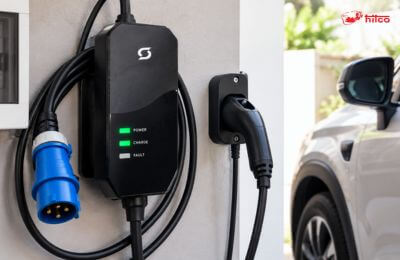
EV charger cost in Nepal usually falls between NPR 30,000 and NPR 65,000 for a home AC charger with installation. A basic 3.3 kW unit sits at the lower end, while a 7.4 kW wallbox costs more, especially once wiring and protection devices are added.
If you have just bought an EV, or you’re about to, the charger is one of the first costs to plan for. You can charge from a normal socket, but a dedicated AC charger is safer and much faster. The EV charger cost is not one fixed number, though. It changes with the charger’s power rating, brand, connector type, smart features, and how much electrical work your home needs.
If you are looking to buy a home or commercial unit, explore Hitco’s complete range of EV Charger Price in Nepal to compare models and specifications.
This guide breaks down EV charger cost in Nepal by charger size, from 3.3 kW and 7.4 kW home units to 11 kW and 22 kW commercial AC chargers.
Quick Summary: EV Charger Cost in Nepal
Charger Type | Best For | Price |
3.3 kW AC | Small EVs, overnight or portable charging | NPR 30,000 |
7.4 kW AC | Home charging for most EV cars | NPR 65,000 |
11 kW AC (three-phase) | Larger homes, offices | About NPR 65,000–100,000 |
22 kW AC (three-phase) | Hotels, malls, dealerships | About NPR 75,000–130,000 |
EV Charger Types and Prices in Nepal
EV charger price in Nepal vary by power level. All the chargers covered here are AC (alternating current) chargers, the type used for home, portable, and most commercial charging in Nepal.
Home chargers are usually 3.3 kW or 7.4 kW, while 11 kW and 22 kW AC chargers are mostly for larger properties and commercial sites.
3.3 kW EV Charger Price in Nepal
A 3.3 kW charger in Nepal is the entry-level AC option for home charging. It is a portable unit, so it needs little or no fixed installation.
- Price: The Exicom Spin Free 3.3 kW EV charger costs NPR 30,000 at Hitco.
- Charging speed: It fills a 40 kWh battery in about 11–12 hours, which suits overnight charging.
- Key details: Type 2 plug, designed for single-phase supply (check your car’s inlet before buying); IP67 rated, so it can be used outdoors; portable, so you can take it with you.
- Best for: Small EVs, short daily distances, and drivers who charge overnight. It is slow for larger batteries.
7.4 kW EV Charger Price in Nepal
The 7.4 kW charger in Nepal is the most common home AC option for EV cars. You may also see it listed as 7 kW, 7.2 kW, or 7.3 kW, which belong to the same single-phase AC class.
- Price: The Exicom Spin Air 7.4 kW EV charger (single phase) costs NPR 65,000 at Hitco. Hitco includes a free installation assessment with every purchase.
- Charging speed: It fills a 40 kWh battery in about 5–6 hours.
- Key details: Wall-mounted, with smart app control; Type 2 plug, designed for single-phase supply (check your car’s inlet before buying); IP66 rated for outdoor use; suitable for homes, corporate parking, and business complexes.
- Best for: Batteries of 25 kWh or more and drivers who want faster overnight charging. It needs a dedicated circuit and proper earthing.
11 kW EV Charger Price in Nepal
An 11 kW charger is a three-phase AC unit. It charges faster than a 7.4 kW wallbox, but only if your building has a three-phase supply and your car can accept 11 kW. Many EVs limit AC charging to about 6.6–7 kW, so they gain nothing from a more powerful charger.
- Estimated price: About NPR 65,000–100,000 for the unit, with installation extra.
- Charging speed: A 40 kWh battery takes about 3.5–4 hours if the car supports it.
- Best for: Larger homes and offices with three-phase power and a compatible car.
22 kW EV Charger Price in Nepal
A 22 kW charger is a commercial-grade three-phase AC unit found at hotels, malls, dealerships, and offices, where cars park for a few hours. It needs a heavier circuit and stronger protection than a home wallbox.
- Estimated price: About NPR 75,000–130,000 for the unit, with installation extra.
- Charging speed: A 40 kWh battery takes about 2 hours, but only in a car that accepts 22 kW AC.
- Best for: Businesses that offer charging to customers or staff.
EV Charger Installation Cost in Nepal
The charger price and the installation cost are two separate numbers. Installation depends on your wiring, your meter, and how far the charger is from your electrical panel, so it varies more than the charger itself.
EV Charger Installation Cost Breakdown
Item | Approx. Cost (NPR) |
Portable 3.3 kW charger (plugs into a suitable socket) | No fixed installation needed |
Dedicated 32A circuit and wiring (7.4 kW wall-mounted charger) | 15,000–25,000 |
Surge protector | 5,000–10,000 |
NEA connection or load upgrade (if needed) | 5,000–10,000 |
Annual maintenance | 2,000–5,000 |
You may not need every item. A basic wall-mounted installation costs about NPR 15,000–25,000. If your home needs circuit upgrades or NEA fees, it can reach about NPR 50,000.
What Does It Cost to Charge an EV in Nepal? (Per-Use Rates)
Once you own a charger, running costs depend on where you charge. Nepal’s hydropower-based grid keeps electricity relatively cheap, so charging costs are far lower than fuel costs for a petrol or diesel vehicle.
- Home Charging (NEA rates): NPR 10–12 per kWh.
- Public AC/DC Stations: NPR 6–20 per kWh, depending on whether it is an NEA public hub or a private provider.
A full charge at home costs far less than a top-up at a public station, so home charging is usually the cheaper option for daily use. Public stations are more useful for topping up on longer trips or if you don’t have access to a home charger.
For context, a 40 kWh battery costs roughly NPR 400–480 to fully charge at home, compared to NPR 240–800 at a public station depending on the provider.
Factors That Affect EV Charger Cost in Nepal
The total cost of an EV charging setup depends not only on the charger itself but also on its power rating, installation requirements, wiring distance, electrical capacity, safety protection, connector type, and smart features. These are the main reasons.
- Power rating (kW): Higher power costs more and charges faster. For example, Hitco’s 3.3 kW Exicom Spin Free costs NPR 30,000, while its 7.4 kW Exicom Spin Air costs NPR 65,000.
- Portable or wall-mounted: A portable charger plugs into a socket and needs no fixed installation. A wall-mounted charger costs more and needs a dedicated circuit.
- Smart features: App control, RFID, scheduling, and load management add to the price. Basic plug-and-charge units cost less.
- Weather and safety protection: An IP66 or IP67 rating suits outdoor use in Nepal’s monsoon. Overcurrent, overvoltage, and short-circuit protection raise the price but protect your car and home.
- Connector type: The charger must match your car’s inlet (Type 2, CCS2, or GB/T). Hitco’s chargers use a Type 2 plug, so check your car’s inlet before buying.
- Brand and warranty: Established brands with local support and after-sales service cost more than generic, unbranded units.
Compare the full cost, including installation, before you choose a charger. The cheapest unit is not always the cheapest setup.
Which EV Charger Should You Choose in Nepal?
The right EV charger depends on your battery size, your daily driving, and your electrical setup, not on the biggest number. Most car owners with a single-phase home connection are choosing between a 3.3 kW and a 7.4 kW charger.
Charger | Suitable For | Choose It If | Watch Out For |
3.3 kW | Home and commercial | You have a small EV, drive short daily distances, and charge overnight. You want the lowest price and no fixed installation. | Slow for larger batteries. A 40 kWh battery takes about 11-12 hours. |
7.4 kW | Home and commercial | Your EV has a battery of 25 kWh or more, and you want to charge it in roughly 5-6 hours. You have a wall to mount it on and want app control. | Needs installation by a licensed electrician. |
11 kW or 22 kW | Commercial, or large homes with three-phase power | Your building has a three-phase supply, and your car can accept that charging rate. | Many EVs limit AC charging to about 6.6-7 kW, so a bigger charger won’t charge them any faster. |
Not sure which charger fits your car and home? Contact Hitco for expert guidance and a free installation assessment with every charger purchase.
Tips to Save Money on EV Charger Installation
Installation can add a lot to your total EV charger cost, but a few simple choices keep it down. These tips help you avoid paying for wiring, features, or power you don’t need.
- Park close to your electrical panel. A shorter cable run means lower wiring cost.
- Compare two or three quotes. Ask each installer to itemize the wiring, protection devices, and labor.
- Ask what the price includes. Check whether installation and protection devices are covered.
- Skip smart features you won’t use. App control and scheduling add to the price.
- Don’t pay for extra power. Check your car’s maximum AC charging rate first.
- Consider a portable charger. A 3.3 kW portable unit needs no fixed installation.
- Get an installation assessment. Hitco offers a free one with every charger purchase.
A little planning before you buy can save thousands of rupees on installation. Compare the full cost, including wiring and protection devices, not just the price of the charger.
Choose Hitco to Buy EV Chargers in Nepal
Hitco supplies certified Exicom AC EV chargers for homes and businesses in Nepal. Here is why buyers choose it:
- Authorized Exicom supplier: Hitco is the authorized supplier of Exicom AC EV chargers in Nepal.
- Established since 1975: Hitco has over four decades of experience supplying industrial and safety equipment in Nepal.
- Two models to choose from: The Exicom Spin Free 3.3 kW costs NPR 30,000, and the Exicom Spin Air 7.4 kW costs NPR 65,000.
- Certified and safety tested: The chargers meet IEC 61851-1 and CE standards. They have IP66 or IP67 weather protection and protection against overcurrent, overvoltage, and short circuits.
- Works with most EVs: Both models use a Type 2 plug and run on a single-phase supply.
- Home and commercial use: Both suit homes, corporate parking, and business complexes.
- Free installation assessment: Every purchase includes an assessment of your electrical setup.
- Delivery across Nepal: Hitco delivers all over the country.
With certified Exicom chargers, clear pricing, and a free installation assessment, Hitco makes it easier to choose the right charger for your car and home. Pick the model that matches your battery size and charging needs, and you can charge with confidence.
Final Thoughts
Choosing an EV charger doesn’t have to be complicated. Start with your car’s battery and how far you drive each day, and the right size usually becomes clear. A portable 3.3 kW charger at about NPR 30,000 is enough for small batteries and overnight charging, while a wall-mounted 7.4 kW charger at about NPR 65,000 suits larger batteries and faster charging. If you’re looking for an affordable EV charger supplier in Nepal, Hitco offers two Exicom AC chargers: the Spin Free 3.3 kW at NPR 30,000 and the Spin Air 7.4 kW at NPR 65,000.
Price is only one part of the decision. Check your car’s connector type, its maximum charging rate, and your home’s electrical setup, and count the installation in the total cost. A charger that matches your car and your home will serve you better and cost you less over time than one that is simply the cheapest or the most powerful.
Looking for a certified EV charger in Nepal? Explore Hitco Nepal, the authorized Exicom supplier serving Nepal since 1975.
Frequently Asked Questions
What is the average price of EV chargers available in Nepal?
EV chargers in Nepal can cost around NPR 30,000 to NPR 130,000 depending on power, brand, features, and installation requirements. At Hitco, the available Exicom chargers range from NPR 30,000 for the Spin Free 3.3 kW to NPR 65,000 for the Spin Air 7.4 kW.
How much does it cost to charge an EV car in Nepal?
Charging at home costs about NPR 10-12 per kWh, so a full charge for a 40 kWh battery is roughly NPR 400-480. A driver who covers 30-40 km a day usually spends about NPR 1,000-2,000 a month.
What is the difference between a 3.3 kW and a 7.4 kW EV charger?
A 7.4 kW charger delivers more than twice the power, so it fills a battery in less than half the time. A 40 kWh battery takes about 5-6 hours on 7.4 kW and about 11-12 hours on 3.3 kW. The 3.3 kW charger is portable and costs less, while the 7.4 kW is wall-mounted and needs installation.
What is the price of a 7.4 kW EV charger in Nepal?
A 7.4 kW EV charger costs about NPR 65,000. It is a wall-mounted, single-phase unit, so installation is extra.
What is the price of a 3.3 kW EV charger in Nepal?
The Exicom Spin Free 3.3 kW portable charger costs NPR 30,000 at Hitco. It needs no fixed installation, so the charger price is your total cost.
What factors determine the total price of an EV charging setup in Nepal?
The total cost depends on the charger’s power rating, brand, installation requirements, wiring, electrical capacity, connector type, safety protection, and smart features. Installation costs can increase if your home needs additional wiring, circuit upgrades, or electrical protection.
What are the different types of EV chargers sold in Nepal and their costs?
EV chargers in Nepal are available in different power ratings, including 3.3 kW, 7.4 kW, 11 kW, and 22 kW AC options. At Hitco, the two available Exicom models are the 3.3 kW Spin Free at NPR 30,000 and the 7.4 kW Spin Air at NPR 65,000.

