

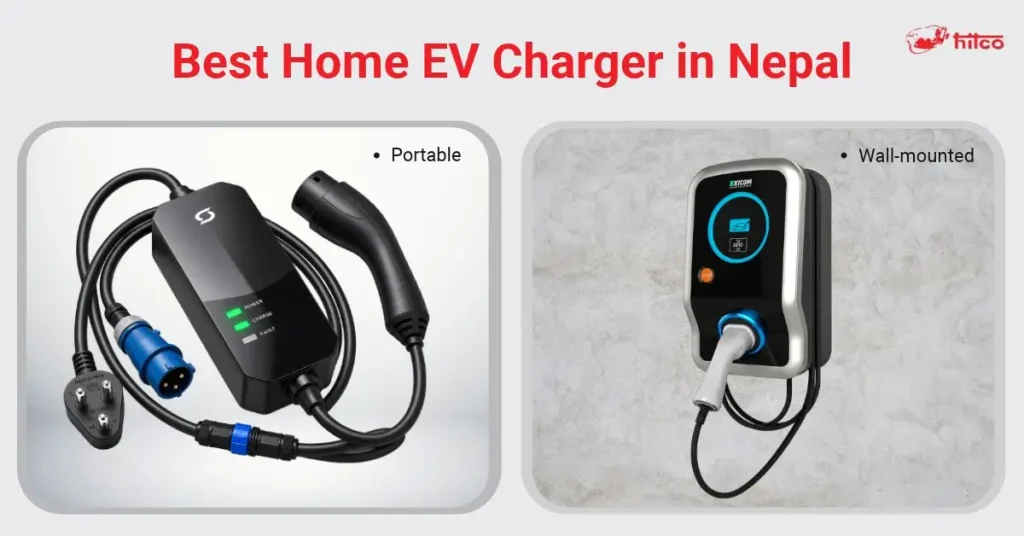
The best home EV charger in Nepal is the Exicom Spin Air 7.4 kW (₨ 65,000) if your car accepts 7.4 kW AC and you want a fixed, faster charger. The Exicom Spin Free 3.3 kW (₨ 30,000) is the best budget and portable pick. Both are sold by Hitco and run on single-phase 230 V.
Before choosing either model, check your car’s charging connector, maximum AC charging rate, and home electrical capacity. These factors determine whether the EV home charger will work with your vehicle and how quickly it can replenish your battery.
This guide compares both models by price, charging power, features, estimated charging time, and installation requirements. It also explains what to check before buying a home EV charger in Nepal.
Quick Answer: What Is the Best Home EV Charger in Nepal?
The best home EV charger in Nepal is the Exicom Spin Air 7.4 kW (₨ 65,000) if you want a fixed, faster charger and your car accepts 7.4 kW AC. If you want a portable, lower-cost charger for overnight charging, the best home EV charger for you is the Exicom Spin Free 3.3 kW (₨ 30,000). Both are sold by Hitco.
Ready to set up home charging for your EV? Buy EV charger in Nepal from HITCO and choose the right model for your vehicle and home.
Key Takeaways: Which Home EV Charger Should You Buy?
Buy the Exicom Spin Air 7.4 kW for a fixed, faster charger, or the Exicom Spin Free 3.3 kW for a portable, lower-cost one. Then check your car’s AC rate and your home’s wiring before you buy.
- Best for fixed home charging: Exicom Spin Air 7.4 kW (₨ 65,000), with app control.
- Best budget option: Exicom Spin Free 3.3 kW (₨ 30,000), a portable overnight charger.
- Best for portability: Spin Free, which you can unplug and carry between places.
- Best for app control: Spin Air, the only one of the two with an app.
- Check your vehicle’s AC charging limit: Make sure it supports the charger’s rated output (3.3 kW or 7.4 kW).
- Check your home’s electrical capacity: Have an electrician verify wiring, breakers, earthing, and protection for the charger’s load.
Exicom Spin Air vs Spin Free: Price and Specifications Compared
The Exicom Spin Air 7.4 kW and Spin Free 3.3 kW differ in charging power, design, and price. Compare their key specifications to find the right option for your vehicle and home charging needs.
Exicom Spin Air | Exicom Spin Free | |
Charging power | 7.4 kW | 3.3 kW |
Price at Hitco | ₨ 65,000 | ₨ 30,000 |
Design | Wall-mounted | Portable |
Maximum output current | 32 A | 13 A (16 A special-order option) |
Vehicle connector | Type 2 | Type 2 |
Power supply | Single-phase | Single-phase |
App control | Yes | No |
Ingress protection rating | IP66 | IP67 |
Standards | IEC 61851-1, CE and other listed standards | IS 17120 (referencing IEC 62752); IEC 61851-1 Annex A |
Main benefit | Higher rated power and app control | Lower price and portability |
Best suited for | Fixed home charging | Portable and overnight charging |
Range estimates depend on vehicle efficiency, charging losses, and actual charging power. They are not guaranteed results.
Exicom 7.4 kW EV Charger: Wall-Mounted Model
The Exicom Spin Air 7.4 kW is a wall-mounted AC EV charger listed at NPR 65,000 by Hitco. It is worth considering if you park in the same place every day and want a dedicated charging point at home or another suitable parking location. Its 7.4 kW output makes 7.4 kW EV charger in Nepal a suitable option for vehicles that support higher AC charging rates.
Its higher rated power can provide faster charging than a lower-powered unit when the vehicle can accept the additional power. The actual charging speed depends on the vehicle, available electrical capacity, and charging conditions.
Key Features and Specifications
- 7.4 kW rated output: Suitable for vehicles that can accept charging at this rate.
- App control: Allows users to check and manage charging status through the supported app features.
- Wall-mounted design: Provides a fixed charging point at a suitable home or commercial parking location.
- IP66 protection: The listed IP66 rating indicates protection against dust ingress and powerful water jets under specified test conditions.
Installation Requirements
The Exicom Spin Air 7.4 kW EV charger requires a suitable electrical connection to support its rated output of up to 32 A. Before installation, Hitco provides a free site assessment to evaluate your home’s electrical setup and determine the installation requirements.
- Electrical supply: Whether your home’s available electrical capacity can support the charger alongside other appliances.
- Wiring and cable distance: Whether the existing wiring is suitable and what additional cabling may be required between the electrical panel and parking area.
- Circuit protection and earthing: Whether the installation has appropriate breakers, protective devices, and a suitable earthing system.
- Mounting location: Whether the wall and parking area are suitable for installing the charger safely and conveniently.
- Total installation cost: Whether additional wiring, electrical upgrades, or other work is needed.
Hitco determines the final installation price after the site assessment, based on your property’s requirements. Contact Hitco to arrange your free assessment and receive a quotation before proceeding with installation.
Who Should Choose the 7.4 kW EV Charger?
Consider the 7.4 kW WV charger if you:
- Have a regular parking space where a fixed charger can be installed.
- Own an EV that supports AC charging at the required rate.
- Want app control, subject to the features available on the supplied model.
- Frequently drive and want the option of replenishing the battery more quickly.
- Have an electrical installation that can safely support the charger’s rated load.
A lower-powered charger may be sufficient if your daily driving is limited or your vehicle cannot accept the higher charging rate.
Exicom 3.3 kW EV Charger: Portable Model
The Exicom Spin Free 3.3 kW is a portable AC charger listed at NPR 30,000 by Hitco. It costs NPR 35,000 less than the Spin Air and may suit drivers who can charge overnight without needing a higher charging rate.
If you need a portable EV charger that you can carry between different locations, the Exicom 3.3 kW EV charger in Nepal offers flexibility without requiring a permanent wall-mounted charging point.
Key Features and Specifications
- Portable design: Can be transported between locations where the required electrical connection is available.
- 3.3 kW rated output: May meet the needs of drivers who replenish relatively small amounts of battery capacity overnight.
- IP67 rating: Indicates a specified level of protection against dust and water ingress under defined test conditions. It does not make every outdoor installation safe.
- Type 2 vehicle connector: The listed vehicle-side connector is Type 2. Check the charging inlet on your particular vehicle before buying, especially if your car was imported in a different market or has a different connector standard.
Electrical Connection Requirements
Do not assume that every household socket can safely support an EV charger for several hours.
Before using the 3.3 kW EV charger, confirm:
- The input plug matches a correctly rated socket.
- The circuit can support the charger’s continuous operating load.
- The wiring, breaker, earthing, and protective devices are suitable.
- The socket and plug are in good condition and show no signs of overheating or damage.
- The installation complies with the manufacturer’s requirements.
Who Should Choose the 3.3 kW EV Charger?
The 3.3 kW EV charger is suitable if you:
- Want a lower-cost EV charging option.
- Prefer a charger that can be carried between compatible locations.
- Usually leave your car parked for several hours overnight.
- Do not need the higher rated output of the Spin Air.
- Have access to a suitable electrical connection.
Consider the Spin Air or another compatible higher-powered charger if charging time is a priority and your vehicle and electrical installation support it.
How Long Does a 3.3 kW vs 7.4 kW Home EV Charger Take to Charge an EV?
The Spin Free needs about 9 to 12 hours, and the Spin Air needs about 4 to 6 hours to fill a 30 or 40 kWh battery from empty. To estimate your own time, divide battery size by charger power.
The following figures are approximate planning estimates for charging from near empty. They assume the vehicle can accept the charger’s rated output.
Battery capacity | Spin Free 3.3 kW | Spin Air 7.4 kW |
30 kWh | About 9 to 10 hours | About 4 to 5 hours |
40 kWh | About 12 hours | About 5 to 6 hours |
These figures assume charging from empty. Real times run slightly longer because of charging losses. Most people charge from 20 to 30% rather than from empty, so real sessions are shorter than the table.
Portable vs Wall-Mounted EV Chargers: Which Is Right for You?
A portable charger offers flexibility, while a wall-mounted charger provides a dedicated charging point. The table below compares the two types, and the second table matches them to your situation.
Your situation | Option to consider | Why |
You want to transport your charger | 3.3 kW | Portable design |
You move between suitable charging locations | 3.3 kW | Can be carried between locations with compatible electrical connections |
You park in one location every day | 7.4 kW | Dedicated wall-mounted charging point |
Your EV supports 7.4 kW AC charging | 7.4 kW | Higher rated output, subject to electrical capacity |
Your EV accepts only 3.3 kW AC | 3.3 kW | A higher-rated charger will not increase the vehicle’s charging limit |
You want app control | 7.4 kW | App control is listed for this model |
You want a lower initial purchase price | 3.3 kW | Lower listed price in this comparison |
The best choice is the one that matches your vehicle, parking arrangement, charging routine, and available electrical capacity.
6 Things to Check Before Buying a Home EV Charger in Nepal
Before purchasing a home EV charger, compare vehicle compatibility, charging speed, electrical requirements, safety features, warranty terms, and smart features. These checks can help you avoid paying for power you cannot use or buying equipment that is unsuitable for your home.
1. Does Your EV Have a Compatible Charging Connector?
Check the AC charging inlet on your vehicle and compare it with the connector specified for the charger.
Both Exicom models in this comparison are listed with a Type 2 vehicle connector. However, connector requirements vary by vehicle, model year, and market. Some imported vehicles may use other connector standards.
Do not rely solely on the vehicle brand. Check the owner’s manual, manufacturer specification sheet, or the vehicle itself before placing an order.
2. What AC Charging Rate Does Your Vehicle Support?
Your EV’s onboard charger determines the maximum rate at which it can accept AC power.
For example, a vehicle with a 3.3 kW onboard AC charging limit will not charge at 7.4 kW simply because a higher-powered wall charger is connected.
Before deciding between the Spin Air and Spin Free, confirm the onboard charger’s rated AC input power. You can usually find this in the vehicle’s manual or technical specifications.
Choose a charger based on the power your car can use, rather than selecting the highest rating available.
3. Can Your Home Electrical System Support the Charger?
A home EV charger draws a sustained electrical load. The suitability of your electrical supply depends on more than whether your property has single-phase power. Check these things:
- Available electrical capacity: Can the home supply support the charger and other appliances at the same time?
- Circuit and breaker: Is the circuit appropriately rated and protected?
- Cable sizing: Are the wiring and cable route suitable for the current and installation distance?
- Earthing: Has the earthing system been checked and confirmed suitable?
- Protective devices: Are the required overcurrent and residual-current protections in place?
The Spin Air’s listed 32 A operating requirement makes a professional assessment especially important. The Spin Free also needs a suitable, correctly rated electrical connection.
4. Which Safety Features Should a Home EV Charger Have?
A home EV charger should have overcurrent, overvoltage, and short-circuit protection, a named safety standard, and an IP rating suited to rain and dust. Voltage fluctuates in some areas of Nepal, so the protections matter.
Both Exicom chargers are built to IEC 61851-1 and CE, and the Spin Free is IP67 while the Spin Air is IP66. Also inspect the cable and plug, because a loose connector can overheat.
5. What Warranty and After-Sales Support Should You Check?
A good EV charger warranty covers the charger body, cable, and plug, states how long the cover lasts, and names a local service contact in Nepal.
It should also say whether the warranty stays valid if the charger is installed by someone other than the seller. Get these terms in writing before you buy, because a charger that has to be sent abroad for repair isn’t much help when your car is at 10% battery.
6. Do You Need App Control for Your Home EV Charger?
A smart home EV charger can make charging more convenient by allowing you to monitor charging status and manage supported functions through a mobile app. The Exicom Spin Air 7.4 kW includes app control, making it worth considering if connected charging features are important to you.
The 7.4 kW EV charger is listed with app control, while the 3.3 kW EV charger in this comparison is listed without app control.
If you plug in your vehicle when you arrive home and unplug it the next morning, you may not need connected features. If monitoring or remote management matters to you, confirm the precise app capabilities before buying.
Final Thoughts
The best home EV charger in Nepal is the one that fits your car and your home. Start with EV charger compatibility: your car’s plug type and AC charging rate decide which charger works.
Choose the Exicom Spin Air 7.4 kW (₨ 65,000) if your car accepts 7.4 kW and you want a fixed, faster charger with app control at one parking spot. Choose the Exicom Spin Free 3.3 kW (₨ 30,000) if you want a portable, lower-cost charger for overnight charging that you can unplug and take with you. For most homeowners who park in the same spot every day, the wall-mounted Spin Air is the better long-term choice.
Not sure which charger fits your car and home? Hitco is an authorized supplier of Exicom EV chargers in Nepal. Contact Hitco with your car model and parking setup to get the right charger and an installation price.
Frequently Asked Questions
What are the best home EV charger options available in Nepal?
The Exicom Spin Air 7.4 kW (₨ 65,000) is the best for daily charging at a fixed spot, if your car accepts 7.4 kW AC and your home can carry about 32 A. The Exicom Spin Free 3.3 kW (₨ 30,000) is the best budget and portable pick.
What is the cheapest home EV charger in Nepal?
The cheapest home EV charger at Hitco is the Exicom Spin Free 3.3 kW at ₨ 30,000. It is portable and needs no wall installation.
Which is the most reliable home EV charger in Nepal?
A Level 2 AC charger is the most reliable choice for home use, and the Exicom Spin Air 7.4 kW, sold by Hitco, is the pick for daily charging at a fixed spot. It is IEC 61851-1 and CE certified, with IP66 protection and app control.
Should I buy a portable or a wall-mounted home EV charger?
Buy a portable if you want a charger you can unplug and carry between places. Buy a wall-mounted if you want one fixed, faster charging point at your parking spot. For most homeowners, wall-mounted is the better choice because it charges faster and stays ready at one spot.
How much does home EV charger installation cost in Nepal?
The installation cost for a home EV charger in Nepal depends on the cable length from your panel to the parking spot, any breaker or wiring upgrades, earthing work, and whether the charger is portable or wall-mounted. Hitco offers a free site assessment with every order, then gives you the price for installing the EV charger and recommends the right charger for your setup.
Where can I buy an EV charger for home in Nepal?
You can buy an EV home charger from Hitco, an authorized supplier of Exicom EV chargers in Nepal. Hitco offers the Exicom Spin Air 7.4 kW, a wall-mounted, and portable Spin Free 3.3 kW models of EV charger in Nepal.

