

The cost of refilling a fire extinguisher in Nepal typically ranges from NPR 1,200 and above, depending on the extinguisher type, cylinder size, extinguishing agent, and whether additional servicing or hydrostatic testing is required.
ABC dry powder extinguishers are generally the most affordable to refill, while CO₂ and clean agent extinguishers cost more because they require specialized equipment and materials.
This guide breaks down fire extinguisher refilling cost in Nepal by type, explains what affects the price, discusses when a refill is needed, compares refilling with replacement, and outlines what a professional refill service should include.
Overview: Fire Extinguisher Refill Cost in Nepal
- Typical cost: NPR 1,200 above, depending on type, size, and condition
- Refill when the gauge hits the red zone, it’s been used even partially, or the annual inspection tag has expired
- Refill vs. replace: replace small 1–2 kg disposable units; refill 5 kg+ commercial, rechargeable, CO₂, and clean agent units
- How often: at least once a year, non-negotiable for hotels, hospitals, schools, and factories
- A real refill includes weighing, depressurizing, cleaning, refilling, repressurizing, inspecting, hydrostatic testing (if due), and tagging, not just a top-up
Save Time on Fire Extinguisher Servicing: Avoid the legal risks and hassle of transporting pressurized cylinders through local traffic. Book Your Doorstep Fire Extinguisher Refilling Service with Hitco Nepal to get an accurate fire extinguisher recharge cost today.
What is the Cost of Fire Extinguisher Refilling in Nepal?
In Nepal, the approximate cost of refilling a fire extinguisher ranges from NPR 1,200 to higher, depending entirely on the chemical agent type and the physical size of the cylinder. For standard ABC Dry Powder units (the most common type used in offices, homes, and schools), the routine refill cost typically ranges between NPR 1,200 and NPR 1,800 for standard 2 kg to 6 kg capacities.
The table below shows the average market refill prices for the most commonly used ABC dry powder fire extinguishers in Nepal. These are the sizes most businesses, offices, and commercial buildings use for everyday fire protection.
Extinguisher Type | Average Market Refill Price (NPR) |
1,200 | |
1,600 | |
1,800 |
The prices above apply to the most commonly used ABC dry powder fire extinguishers. Other types, such as CO₂ fire extinguishers, mechanical foam (AFFF), and wet chemical extinguishers, are also available, and their refill costs generally depend on the extinguisher type, cylinder capacity, extinguishing agent, and whether additional servicing or testing is required.
These are average market estimates rather than fixed prices. The final refill cost depends on factors such as the extinguisher’s size, brand, overall condition, and whether it requires a standard refill or a complete service.
Want the exact price for your fire extinguisher refilling? Contact a professional fire extinguisher refilling provider like Hitco.
What Affects Fire Extinguisher Refilling Cost in Nepal?
Five things move the price up or down: cylinder size, agent type, cylinder condition, hydrostatic testing, and whether it’s a refill or a full service.
Cylinder Size
A 2 kg fire extinguisher costs less to refill than a 9 kg or 22 kg cylinder; more agent, more cost. This is why a small kitchen extinguisher and a large warehouse cylinder can show the same “ABC dry powder” label but land on completely different ends of the price range.
Type of Agent
ABC dry chemical powder extinguisher refills are generally the cheapest. CO₂ fire extinguisher refill cost runs higher because the gas has to be weighed and filled under pressure with specialized equipment. Clean agent units cost the most, since the agent itself is expensive and less commonly stocked.
Cylinder Condition
Rust, dents, or a damaged valve can mean parts need replacing or the cylinder fails inspection altogether, pushing the cost of refilling a fire extinguisher higher than a routine job. This matters most for older units that have sat outdoors or in humid storage areas, since corrosion isn’t always visible until the cylinder is opened up for refilling.
Hydrostatic Testing
Cylinders need periodic hydrostatic testing, pressure-testing the cylinder itself, not just the contents, to confirm it’s still safe to hold pressure. If your unit is due, it adds to the bill, but it isn’t optional. It’s what keeps the cylinder from failing under pressure.
Refill vs Full Service
A quick top-up of powder or gas is different from a full service of weighing, checking the pressure gauge, inspecting the hose and nozzle, and replacing the safety pin and tamper seal. Most reputable providers do the full service, not just a top-up, because a refill without inspection isn’t much of a guarantee.
Fire Extinguisher Refilling vs. Replacement: Which One Makes Sense?
For small 1–2 kg units, replacement usually costs about the same as refilling. For larger or specialty units, refilling is the cheaper option.
Extinguisher Type / Size | Better Choice | Why |
1kg–2 kg disposable units (e.g., car extinguishers) | Replace | Refill cost + required service tag often equals or exceeds the price of a new unit |
5 kg+ commercial units | Refill | Built for repeated servicing over a long working life; refilling is significantly cheaper than replacing |
Rechargeable metal cylinders | Refill | Designed to be serviced repeatedly, not discarded |
CO₂ / Clean Agent specialty units | Refill | New units cost much more; refilling is the economical route |
If you’re not sure which category your extinguisher falls into, the capacity and agent type printed on the label are usually enough for a supplier to tell you quickly.
When Should a Fire Extinguisher Be Refilled?
Refill it as soon as the pressure gauge drops into the red zone, it’s been used even partially, or the annual inspection tag has expired. As a general rule, every fire extinguisher should get a full inspection at least once a year, even if none of these signs show up.
Other signs it’s time:
- Visible damage, rust, or a stuck pin: any of these can mean the unit won’t discharge properly when needed, even if the gauge still reads normal
- A CO₂ cylinder that’s lost weight: CO₂ units don’t always show pressure loss on a gauge the way powder units do, so they’re checked by weighing against the stamped weight on the cylinder
Why Monsoon Humidity Matters
In Nepal’s climate, moisture can affect dry chemical powder over time, causing it to clump inside the cylinder instead of discharging as a fine spray.
The same humidity accelerates rust on the cylinder body and valve, which is why units stored outdoors or in damp storage rooms tend to need refilling sooner than ones kept indoors. An annual inspection catches this before it becomes a bigger problem.
Why Compliance Deadlines Matter More for Commercial Buildings
For hotels, hospitals, schools, and factories, annual inspection isn’t optional; in practice, it’s usually tied to fire safety compliance and insurance requirements, and an expired tag can be flagged during a routine audit.
Waiting for a fire drill or an audit to find out an extinguisher is empty puts both compliance status and actual safety at risk at the same time.
What Does a Fire Extinguisher Refill Actually Include?
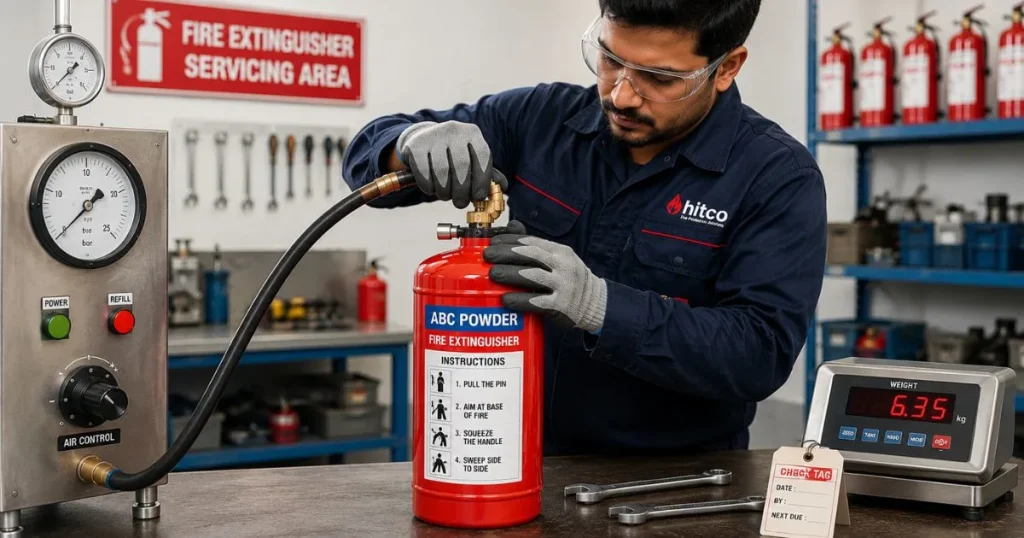
A proper refill involves eight steps: weighing, depressurizing, cleaning, refilling, repressurizing, inspecting, testing, and tagging.
- Weighing the cylinder to confirm how much agent is left
- Depressurizing the unit safely
- Removing and cleaning the valve assembly
- Refilling with the correct agent and quantity for that cylinder
- Repressurizing to the correct level and checking the pressure gauge reads within the safe operating range
- Inspecting the hose, nozzle, and safety pin for wear that could cause a leak or blockage under pressure
- Hydrostatic testing, if the cylinder is due for it, to confirm the cylinder itself can still safely hold pressure
- Tagging the unit with the service date as part of routine fire extinguisher maintenance records
Skipping any of these steps is how you end up with an extinguisher that looks serviced but isn’t reliable when you actually need it. This is also the difference between a real fire extinguisher inspection and a quick top-up. The steps above are what a compliance audit or insurance check will actually look for.
Why Hitco's Refilling Process Is Different
Many local repair shops in the Kathmandu Valley cut corners by refilling cylinders with low-grade 30%–40% monoammonium phosphate (MAP) powder. These lower-quality compounds can clump over time and may not perform effectively during a fire.
At Hitco, we use premium 70% MAP dry chemical powder for ABC fire extinguisher refills to deliver reliable fire suppression. Our CO₂ extinguishers are also refilled using dedicated, calibrated gas-pumping equipment at our Maharajgunj service center, ensuring each cylinder is accurately filled rather than simply “topped up.”
Why Can't Commercial Buildings Delay Fire Extinguisher Servicing in Nepal?
A homeowner with one or two extinguishers can afford a slower approach. A hotel, hospital, school, warehouse, or factory can’t have the fire safety equipment covering one building; it usually spans several extinguisher types at once, each tied to a different servicing schedule.
A hotel kitchen needs a foam or wet chemical unit serviced on its own cycle; the server room needs a CO₂ unit checked separately, and general corridors or storage areas run on ABC powder units with their own inspection dates. Missing one type because attention went to another is a common gap in larger properties.
Commercial buildings rely on the principles of fire protection engineering to manage fire risks through proper system design, inspection, and maintenance.
Getting this wrong isn’t just a compliance risk. It’s a safety risk for staff, guests, patients, or students, and it’s the kind of thing that gets flagged hard during an insurance or fire safety audit.
Choose Hitco for Fire Extinguisher Refilling in Nepal
Fire safety is too important to leave with just any supplier. Hitco Nepal has serviced extinguishers for homes, hotels, hospitals, schools, and factories across the country for over five decades, and every refill is backed by genuine parts and real after-sales support.
- Established in 1975: over 50 years of fire safety expertise in Nepal
- Authorized distributor of leading brands: Ceasefire, Safe Pro, SRI, AGNI, NewAge, and more
- ABC refills mapped to 70% powder fill for reliable, full-strength coverage
- Every refill backed by a 3-year warranty
- Full fire safety systems and equipment supplied, not just individual extinguishers
Getting your extinguisher refilled at Hitco means it’s handled by the same team that’s supplied fire safety equipment across Nepal since 1975, not a one-off top-up from someone who won’t be there if something goes wrong later.
Whether you are looking for localized fire extinguisher refilling “near me” or need bulk commercial maintenance tracking across branches, we provide direct service across the following: Kathmandu Valley: Coverage throughout Kathmandu, Lalitpur, and Bhaktapur. Also outside valley in Pokhara, Biratnagar, Birgunj, Chitwan, Nepalgunj, and Dhangadhi.
Final Thoughts
Fire extinguisher refilling cost in Nepal comes down to three things: the extinguisher’s type and size, its condition, and whether it needs a full service rather than a quick top-up. Whether refilling or replacing makes more sense depends mostly on the unit’s size; small disposable units are often better replaced, while larger and specialty units are worth refilling.
None of this matters, though, if fire extinguisher maintenance gets pushed to “later.” Two habits are worth keeping regardless of who services your extinguishers: check the pressure gauge every few months instead of assuming it’s fine, and book an annual inspection instead of waiting for an audit, a drill, or an emergency to reveal a gap.
Ready to refill and service your fire extinguishers? Contact Hitco today for a refill, inspection, or straight quote.
FAQs for Fire Extinguisher Refilling Costs in Nepal
Is fire extinguisher refilling mandatory in Nepal?
For hotels, hospitals, schools, and factories, yes, it’s usually tied to fire safety compliance and insurance requirements. For private homes, it isn’t legally enforced, but an empty extinguisher is still a real safety gap.
How long does a fire extinguisher refill take?
Usually same-day to 1–2 days. It takes longer only if the cylinder also needs hydrostatic testing or replacement parts.
Can I refill a fire extinguisher myself?
No. It requires pressure equipment, calibrated weighing, and trained handling of compressed gas or dry chemical agent; this should only be done by a certified provider.
How often should a fire extinguisher be inspected?
At least once a year, even if the gauge and cylinder look fine. Inspection is what tells you whether a refill is actually needed.
What's the difference between a fire extinguisher refill and a recharge?
They’re the same service. “Recharge” is used more often for CO₂ units, while “refill” is more common for ABC powder units.
Does Hitco provide fire extinguisher refilling across Nepal?
Yes. Hitco services extinguishers across Kathmandu Valley and beyond, alongside supplying full fire safety systems for homes, hotels, hospitals, and factories nationwide.

