

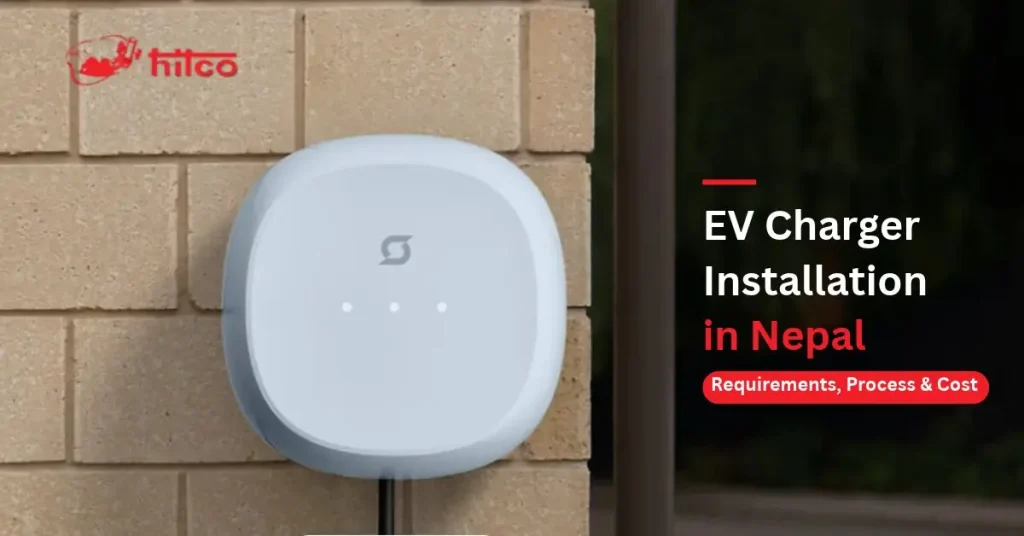
EV charger installation in Nepal needs four things: a charger that matches the vehicle’s charging port, a power supply that can carry the load, a dedicated protected circuit, and a qualified electrician to fit and test the unit. Choosing the right EV charger in Nepal is an important first step, but you should also check whether your home’s electrical supply can support its power requirements.
Many buyers choose a EV charger first and check the electrical supply later. That order causes trouble. An older household connection or shared meter may not have enough capacity to support the charger’s power requirements. Fixing the wiring after the charger arrives costs time and money, and a poorly protected circuit creates a real fire and shock risk.
This guide covers the requirements, the step-by-step process, and the cost factors. It also compares AC and DC chargers, lists suitable locations, and explains the mistakes that cause most failed installations.
EV Charger Installation in Nepal: Key Takeaways
- Requirements: The car’s port, a supply that can carry the load, a dedicated protected circuit, a mounting spot, and permission to install.
- Process: Site check, charger selection, electrical preparation, mounting, and then a safety test.
- Charger type: A Level 2 AC charger, such as a 7.4 kW EV charger, covers most homes. DC fast chargers belong at commercial sites.
- Locations: Homes are the simplest. Apartments need building approval, and commercial sites usually need several chargers.
- Cost: It depends on the charger and the site work.
- Biggest mistake: Buying before checking the supply, which leads to the wrong size or missing protection.
What Are the Requirements for EV Charger Installation in Nepal?
EV charger installation in Nepal needs a charger that fits your vehicle’s port, a power supply that can carry the load, and a dedicated circuit with proper protection. You also need a good mounting spot and permission to install.
Here is what the installation needs:
- Compatible charger: Match the plug type and charging rate to your car. A mismatch means slow charging or none at all.
- Enough supply: Your meter and wiring must handle the charger’s full current for hours at a stretch. A weak supply heats up and keeps tripping.
- Dedicated circuit: Give the charger its own cable and breaker straight from the distribution board. If it shares a line with lights and sockets, that line overloads.
- RCD and earthing: You need both a residual current device (RCD) and proper earthing. When a fault happens, they cut the power fast, so no one gets shocked and nothing catches fire.
- Mounting spot: Pick a solid wall or pedestal near the distribution board and within cable reach of your parking spot. Shorter runs cost less.
- Permissions: Apartment residents need approval from the owner or building management first. Skip it, and you could be told to take the charger down.
What Is the EV Charger Installation Process in Nepal?
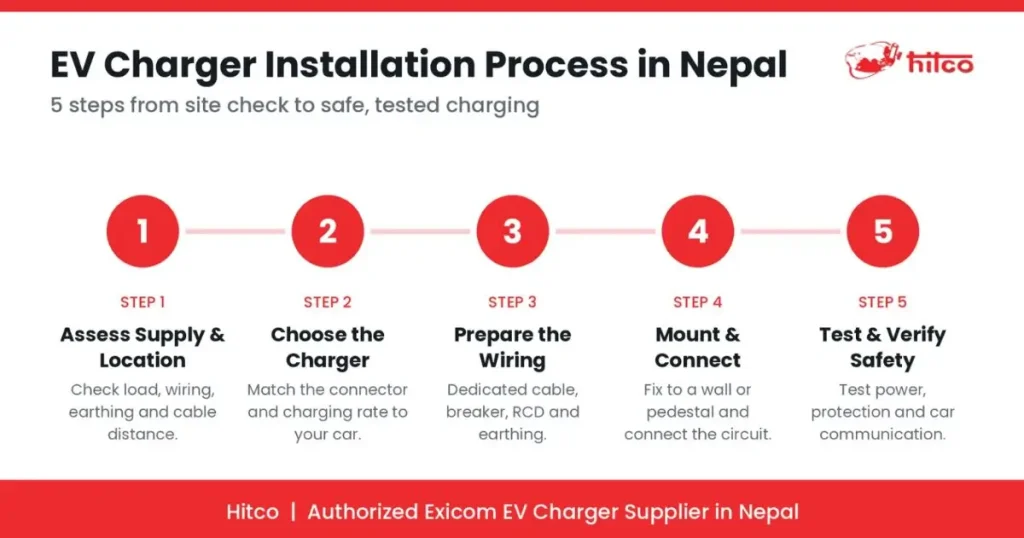
The EV charger installation process in Nepal has five steps: check the electrical system, choose the charger, prepare the wiring, mount and connect the unit, and then test everything. Following these steps helps ensure that the charger works correctly and safely with your vehicle.
Step 1: Assess the Electrical System and Installation Location
Start by checking your property’s electrical capacity and the available space for installation. An electrician should assess the existing load, wiring, earthing, power supply, and the distance between the electrical panel and the parking area.
Step 2: Choose the Right EV Charger
Pick a charger that fits your car’s connector and the charging rate your supply can handle. For home use, an AC charger is usually the best home EV charger, while DC fast chargers are meant for places that serve many vehicles.
Step 3: Prepare the Electrical Connection
Run a separate cable from the distribution board to the charger spot, and put a breaker, RCD, and earthing on that line. Choose the cable size by the charger’s current, and take a thicker cable if the run is long.
Step 4: Install and Connect the EV Charger
Fix the charger to a wall or pedestal so the cable reaches the car’s port without pulling tight. Connect it to the new circuit, and for outdoor parking use a unit like the Spin Air, which has IP66 dust and water protection and IK10 impact resistance.
Step 5: Test the Charger and Ensure Safety
After installation, test the charger to confirm that it supplies power correctly and communicates with the vehicle. Check the electrical connections, protective devices, earthing, and charging operation before using it regularly.
Which Type of EV Charger Is Suitable for Installation in Nepal?
The suitable EV charger for installation in Nepal depends on whether you are setting it up for home/private use or a public/commercial station, as well as the specific charging inlet of your electric vehicle. For most private properties, that points to an AC charger.
AC EV Chargers
AC chargers send alternating current to the car, and the car’s onboard charger converts it for the battery. They come in two levels:
- Level 1 chargers: These run from a regular household socket using the cable that comes with the car. They are slow, so they work better as a backup.
- Level 2 chargers: These are dedicated wall-mounted or portable units, such as 3.3 kW or 7.4 kW models. They charge much faster and come with proper protection built in.
A Level 2 AC charger is the best choice for most homes. For single-phase homes with a 32 A supply, the 7.4 kW EV charger is the best fit.
DC Fast Chargers
DC fast chargers convert power inside the unit and feed the battery directly, which makes them much faster than AC. They suit public stations, highway stops, and fleet depots. The equipment and the power connection are far bigger, so they do not make sense for a home.
Where Can You Install an EV Charger in Nepal?
An EV charger can be installed at homes, in apartment parking, and at commercial sites. Every location needs a protected supply, a mounting spot near the parking spot, and permission from whoever controls the space.
EV Home Charger Installation
EV home charger installation is the simplest case, since the owner controls both the property and the parking spot.
- Best spot: A garage wall or covered spot near the distribution board, which keeps the cable run short.
- Supply: A single-phase supply with spare capacity usually handles a unit.
- Check: the capacity during the site check.
Apartment and Residential Parking Installation
Installing an EV charger in an apartment requires additional planning because parking areas and electrical connections may be shared between residents. You may need approval from the property owner, building management, or relevant authority before setting up a private charging point.
- Approval: Get written permission from the building owner or management committee before drilling or wiring.
- Metering: The charger needs a way to track power use. NEA’s bylaws let apartment residents and tenants take separate meters under set conditions.
Commercial EV Charger Installation
Offices, hotels, malls, and fleet parking suit commercial EV charging station installation.
- Several chargers: These sites often need multiple units with load sharing.
- User access: Authentication and usage tracking are common.
- Public stations: NEA has separate arrangements for public charging stations, covering electricity supply and tariff.
How Much Does EV Charger Installation Cost in Nepal?
EV charger installation cost in Nepal depends on your setup: a portable home charger, a wall-mounted home charger, or a commercial charging station. Each needs different electrical work, so your supplier can only give a final figure after a site visit.
Here is what the installation cost depends on for each setup:
- Portable home charger: The cost depends on the dedicated socket point, its breaker and RCD, earthing, and the distance from the distribution board. It is usually the cheapest setup because the wiring work is small.
- Wall-mounted EV charger: Depends on cable and conduit length, circuit rating, breaker and RCD, earthing, mounting, and whether your meter or connection needs an upgrade. A long cable run or an upgrade is where the bill grows fastest.
- Commercial charging station: The cost depends on supply capacity, transformer needs, the number of chargers, load sharing, and NEA approval for public use. Several chargers on one supply need much more planning than a single home unit.
What Should You Consider Before Installing an EV Charger?
Before installing an EV charger, consider your vehicle’s compatibility, electrical capacity, charging speed, installation location, and long-term charging requirements. Checking these first keeps you from buying the wrong charger or paying for upgrades you didn’t plan for.
- Vehicle compatibility: Check your car’s connector type and the highest AC or DC charging rate it accepts. A charger built for a different connector won’t plug in, and one with a lower rate charges slower than the car could.
- Charging speed: Work out how far you drive in a day, then pick a rate that refills that distance overnight.
- Electrical capacity: Have an electrician confirm that your meter, wiring, and distribution board can carry the charger’s current for hours. If they can’t, the upgrade has to be done before installation, and it adds to the total cost.
- Installation location: Choose a spot that is easy to reach, with room for the charger and enough cable length from the board.
- Safety features: Check the charger’s listed protections, and make sure your circuit has earthing and an RCD. A charger parked outside also needs a high ingress rating, since rain and dust get into units that lack one.
- Installation cost: Add up the charger, cable, breaker, labor, and any upgrade to the supply.
- Warranty and support: Buy from a supplier that sells genuine units and backs them with warranty and service. If the charger fails, you know who to call for a repair or replacement.
Common EV Charger Installation Mistakes to Avoid
The most common mistakes are buying a charger that doesn’t fit the car, ignoring the electrical load, using weak wiring or protection, picking a bad location, and skipping professional testing. Each one can cause slow charging, repeated tripping, or a fire risk.
- Choosing an incompatible charger: Don’t buy before checking your car’s connector type and maximum charging rate. A wrong connector won’t plug in, and a low rate wastes the car’s capacity.
- Ignoring electrical load: Don’t assume your supply can carry the charger. Charging runs for hours, and an overloaded supply heats up and trips.
- Using unsuitable wiring or protection: Don’t use thin cable or skip the breaker, RCD, or earthing. Undersized cable overheats, and missing protection means a fault can cause shock or fire.
- Picking a poor location: Avoid spots that are hard to reach, need a long cable, or have no weather cover. A bad location raises the cable cost, and rain and dust shorten the life of an unprotected unit.
- Skipping professional installation and testing: Don’t switch the charger on before a qualified person has tested it. Wiring faults often stay hidden until the charger has run under full load for a while.
Why Should You Choose a Professional EV Charger Installation Service?
You should choose a professional installer because charging runs at high current for hours, and mistakes in cable size, protection, or earthing can stay hidden for weeks. A qualified installer checks the parts a homeowner can’t check alone.
A reliable installation service can help with:
- Electrical assessment: The installer checks your meter, wiring, and spare capacity before quoting. This stops you from buying a charger your supply can’t run.
- Charger selection: Installer matches the charger to your car’s connector and your supply. That avoids a unit that plugs in but charges slowly.
- Safe installation: Handling wiring, mounting, connections, breakers, RCDs, and earthing. Getting these right is what prevents overheating and shock.
- System testing: Checking the charger under load and testing the breaker and RCD. A fault found on day one costs far less than one found after a month.
- After-sales support: The supplier handles warranty and repair questions. If something fails, you have one place to call.
Choose Hitco for EV Charger Installation in Nepal
Hitco is the authorized supplier of Exicom AC EV charger in Nepal, and every purchase includes an assessment of your electrical setup before installation. Here is why you should Hitco:
- Free installation assessment: Every purchase includes an assessment of your electrical setup.
- Authorized Exicom supplier: Hitco is the authorized supplier of Exicom AC EV chargers in Nepal.
- Established since 1975: Hitco has over four decades of experience supplying industrial and safety equipment in Nepal.
- Delivery across Nepal: Hitco delivers all over the country.
- Product guidance: Help selecting a charger based on your vehicle and electrical requirements.
Final Thoughts
EV charger installation in Nepal goes smoothly when the order is right: supply check first, charger second, and wiring and testing by a licensed electrician. Get that order wrong, and small problems turn into rework.
An A Level 2 AC charge 7.4 kW EV charger is best for most homes. A 3.3 kW portable unit fits lighter use or tighter limits, and DC fast charging belongs at commercial sites. Before buying, confirm the car’s AC charging rate, the meter capacity, and any approval needed from the building owner.
If you want to buy an EV charger with the installation assessment. Contact Hitco for product guidance and installation assessment.
Frequently Asked Questions
What are the requirements for Level 2 EV charger installation at home in Nepal?
Level 2 EV charger installation at home in Nepal requires a charger that matches the car’s port, a supply that can carry the load, and a dedicated circuit with an RCD and earthing. The home also needs a mounting spot near the distribution board.
How do I find a certified EV charger installer in Nepal?
To find a certified EV charger installer in Nepal, choose a licensed electrician or an authorized charger supplier who offers installation support. Ask whether they check the supply before installation, fit the RCD and earthing, and test the charger with your car. Hitco, the authorized Exicom supplier in Nepal, supports installation of the chargers on it.
What electrical upgrades might I need before installing a home EV charger?
The upgrades you might need before installing a home EV charger are a dedicated breaker, an RCD, proper earthing, and a heavier cable for long runs. If the approved load is too low, a higher-capacity meter or supply upgrade through NEA may also be needed. The site assessment shows which of these apply.
Can I install an EV charger in a rented apartment in Kathmandu?
Yes, you can install an EV charger in a rented apartment in Kathmandu with written approval from the owner or building management. The charger also needs a way to track your power use. NEA’s distribution bylaws allow tenants to take a separate meter under set conditions, and a portable unit can move with you when you leave.
Which companies offer EV charger installation for businesses in Nepal?
Hitco offers EV charger installation support for businesses in Nepal as the authorized supplier of Exicom chargers. Businesses with several parking spots should share the number of vehicles, the parking layout, and the available supply so the team can plan the chargers and load sharing.
Can I install an EV charger at home in Nepal?
Yes, if the home supply can carry the charger’s load. A 7.4 kW single-phase unit needs a 32 A supply and a dedicated protected circuit. If the approved load is too low, NEA allows a separate meter for vehicle charging.
How much does EV charger installation cost in Nepal?
It depends on the charger and the site work, so it differs from one property to the next. A site review gives an exact quote.
Which EV charger is suitable for home installation?
A Level 2 AC charger. A 7.4 kW unit EV charger is suitable for home installation. It charges much faster and more safely for continuous use than a standard wall outlet
How long does it take to install an EV charger?
It depends on the cable distance, the state of the existing supply, and whether a meter upgrade is needed. A wall-mounted unit near the distribution board takes the least time.
Is professional EV charger installation necessary?
Yes, professional EV charger installation is necessary because cable size, protection devices, and earthing all have to be right for hours of high-current charging. Professional testing also supports warranty claims.
How do I book a site assessment for EV charger installation?
To book a site assessment for EV charger installation, contact Hitco by phone at +977 985-1253028/+97714017706 or on WhatsApp. Send the car model, the parking location, and a photo of the meter and distribution board so the team can review your setup.

